
On June 27, 2018, referring to Article 19 of the Law of Ukraine “On the National Archival Fund and Archival Institutions”, the Ministry of Justice of Ukraine amended its order «On the Use of Documents of the National Archival Fund of Ukraine of November 19, 2013 No. 2438/5». The amendments immediately caused a flurry of discussions and public outrage. How, after six months of operation, have these changes affected the work of ordinary visitors in the archives of Ukraine?
Already the first user reviews have shown that the changes of the Ministry of Justice contain a number of innovations that have complicated the work of researchers in archives. At the same time, the Ministry of Justice and the State Archival Service of Ukraine emphasize the positive aspects of this document. Therefore, it is necessary to understand the intricacies of the order, known as "Changes to the Procedure for Using Documents of the National Archival Fund of Ukraine Belonging to the State and Territorial Communities" and the consequences of its implementation.
The most scandalous provision of the order concerns the right of ordinary visitors to the archive to copy documents free of charge using their own technical devices (according to paragraph 6 of section V of this order), because upon closer examination of the document it becomes clear that the new procedure for using archival documents makes it practically impossible for a researcher to make copies on their own. In conditions when a visitor to the archive has practically no right to make such copies, such a provision sounds quite cynical.
Section V, paragraph 2, states that copying of documents may only take place under a special agreement between the archive and the user. This actually creates a number of unnecessary bureaucratic points in the researcher's work with archive funds, but at present, in most archives, ordering copies is accompanied only by filling out the appropriate form with its subsequent endorsement by the archive directorate and providing a receipt for payment of the service.
The order states that the right to copy is possible only if there is a specially designated place for this (a table or a separate room for making copies), and the copying itself must take place in the presence of an archivist. In fact, most archives still do not have appropriately adapted premises. If such premises are already provided, very often due to the excessive number of visitors, there is simply no opportunity and space for photocopying. This norm has made life difficult not only for researchers, but also for the archives themselves.
The changes also affected the means by which copying can be done. In particular, the use of contact technical means (scanners, copiers) and any fixing means that can damage the document is prohibited. The creators of this document probably do not know that today there are contactless scanners that are capable of copying very qualitatively, quickly and without unnecessary damage to the document. However, this norm is already in effect and a number of researchers have already encountered the fact that such contactless scanners can no longer be used in the archive.
The document of the Ministry of Justice does not directly mention the ban on copying all documents of the National Archival Fund of Ukraine, instead it refers to the ban on copying documents larger than A4 format and files with a spine thickness of more than 4 centimeters, as well as documents made with iron-head ink, gouache, pencil and with fading text. Archivists argue the bizarre norm on the ban on copying files with a spine thickness of more than 4 cm by saying that constant use and opening of these files breaks the binding and tears the archival documents.
Again, the standard for using the A4 format was adopted in Germany back in 1922 (the modern qualification of paper formats), the USSR joined this standard only in 1934, and in Western Ukraine it was introduced into circulation only after World War II. The prohibited type of ink was widely used until the 20th century. In total, almost 80 % visitors to the archives of Ukraine work with Soviet cases, the format of which, accordingly, is larger than A4. Thus, it becomes obvious that the prohibition of copying applies to the absolute majority of archival documents.
We have two opposing points of view on the outlined norms of the Order - ordinary visitors to archives believe that the changes proposed by the Ministry of Justice have not simplified the use of archival documents, but rather made them more complicated. On the other hand, archival workers and archive management in particular argue that such strict rules are a positive change, as they will contribute to better preservation of archival materials.
Visitors to archive reading rooms disagree with archivists' arguments, as the restrictions mean they have to spend even more time researching, reading, taking notes, and processing documents. This means that the documents themselves are exposed to sunlight and direct contact with the researcher for longer periods of time, and as a result, they deteriorate more quickly.
Truly high-quality, innovative historical research can be created primarily on archival materials that have not yet been put into scientific circulation. Ukrainian graduate students, applicants for scientific degrees, and ordinary scientists cannot afford the luxury of ordering copies of documents from the archive, because the average cost of a copied document in the Central Historical Archive of Lviv or Kyiv is currently about 50 hryvnias, while just one archival file can contain dozens of such documents.
Before the changes in this situation, thanks to free access to photocopying materials in many Ukrainian archives, many enthusiasts managed to scan or photograph a significant amount of valuable information, which was made freely available, providing the opportunity to work with these materials remotely to other researchers. Still, it is obvious that the future lies in the digitization of archival documents - it significantly saves time and resources for researchers, unloads the reading rooms of archives, and most importantly - preserves the documents themselves. An example can be the experience of neighboring Poland, where archives are actively working on digitizing metric books and providing free access to them via the Internet.
The operation of the Regulations on the Use of Documents of the National Archival Fund of Ukraine has actually legalized the monopoly of archives on making copies of documents. The implementation of copying of materials by the archive is regulated by a separate 5th section of the order of the Ministry of Justice - Organization of copying of documents at the user's request. Point 4 of this section looks curious, which states that copies of NAF documents are made by the archive in accordance with the technical capabilities of the archive itself. It is known that some Ukrainian archives today do not have the means to make high-quality copies! How then to be a researcher who urgently needs such copies? After this resolution of the Ministry of Justice came into force, some time has already passed and on the example of some archives it is already obvious that they are unable to comply with the requirements of point 5 of section V, on the terms of making copies, which cannot exceed one month. For example, today the state archives of Volyn and Zhytomyr regions already have so many orders that they are unable to fulfill researchers' requests for copying within one month.
From an informal point of view, the introduction of changes to the procedure for using NAF documents was caused by a conflict between researchers and archive administrations in connection with the not clearly spelled out norm on free copying of documents of the National Archival Fund of Ukraine. According to archival officials, many visitors to archives make a business out of copying documents, and the archives do not benefit from this, on the contrary, the workload of employees has increased due to an excessive number of orders. However, by introducing a fee for copying, the archives did not solve the existing problem. In market conditions, the archives themselves should take the initiative in satisfying the demand for the growing interest in genealogical research and archival documents in general. And where there is demand, there is a niche for earning money.
Not all innovations of the document concern copying. So, the norm on the need to confirm family ties with persons for whom personal data is being searched does not seem to be fully understood. Archives often require relevant documents, and if the search is carried out in the interests of third parties, the archive must be provided with a notarized power of attorney from the customers of genealogical research. The Law on the Protection of Personal Data applies to documents no older than 75 years. That is, we are talking about documents created after 1944. Why then require people who work with metrics of the 19th - early 20th centuries to confirm family ties? Thus, the ministry's order conflicts with the law related to the protection of personal data.
Among the few positives, it is worth noting that the order provides for the issuance of orders to the reading room, made not only directly in the archive, but also with the "use of information and communication technologies", that is, e-mail in particular. It should be noted that some archives have so far refused to accept orders in this way, and instead the basis for issuing a case was an order form filled out by a visitor in the reading room. Considering that cases are usually issued on the second or even third day after the order, considerable difficulties arise, especially for out-of-town visitors.
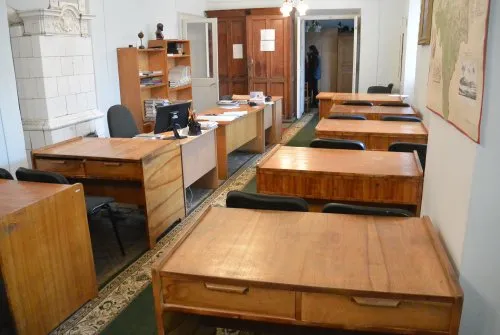
Reading room of the Central State Historical Archive of Ukraine in Lviv
Regarding the limits on the number of received files, the limitation on the number of files issued in electronic form – 20 units – looks quite strange. If physically a dozen archival files, each of which has several hundred sheets, are really difficult to make available to a researcher, then why there are limits on access to electronic files is not clear.
There is also a clause on the postponement of access to documents. Probably every researcher has encountered a situation where a case is not released due to unsatisfactory physical condition, restoration, or scientific and technical processing. The worst thing is that sometimes cases due to one of the above reasons are not released for years! Unfortunately, the order of the Ministry of Justice legalizes postponements of access for all the above reasons, outlining the period during which these reasons must be eliminated, a year with the right to prolong for another year! Moreover, the criterion of unsatisfactory physical condition, which is determined «in accordance with the methodology for assessing the physical condition of documents,» remains very vague.
In conclusion, I would like to end this article on a positive note. Ukraine is slowly but surely moving towards European values, including the right to information (guaranteed by Article 34 of the Constitution of Ukraine). It is believed that the retrograde innovations to the order «On the Use of Documents of the National Archival Fund of Ukraine» are a temporary phenomenon and will soon become only an unpleasant memory, evidence of the incompetence of the unreformed state apparatus of Ukrainian officials.