
Cemeteries, or rather information about deceased relatives from their graves, are one of the important sources of genealogical research. If your family comes from a rural area, it is worth visiting a village cemetery, walking around and photographing inscriptions with familiar surnames. If you have already processed birth records, then based on the information collected at the cemetery, you can supplement birth data from pre-war birth records and civil registry office records with information about the deaths of relatives. Information from graves becomes especially important if birth records have not been preserved. This source also allows you to verify data obtained from oral stories of family members, which can often be inaccurate and contain errors in dates.
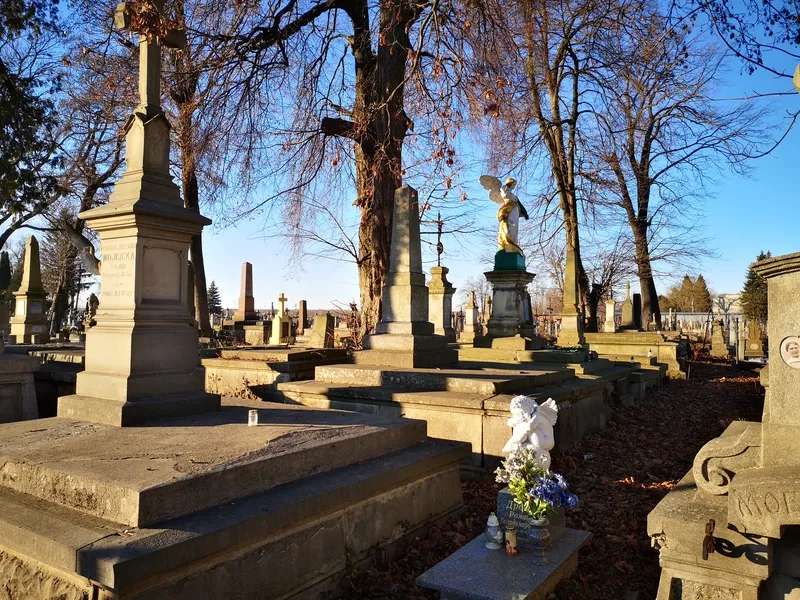
The old part of the cemetery in the city of Sambir
As a rule, most graves in village cemeteries are rarely older than the second half of the 19th century. Why is that? Once upon a time, a simple wooden cross was placed on the grave of a simple peasant. There could be no inscription, because most peasants were illiterate anyway. Time passed, generations changed, and the descendants of the deceased ancestor no longer knew or simply neglected the burial place. The cross eventually collapsed, and the grave settled and grew overgrown with grass. In the case of city cemeteries, old cemeteries around churches were liquidated and new ones were opened outside the city.
Graves carved from stone, poured from concrete mortar, or made of metal structures can last much longer. Such burials could be afforded by representatives of wealthy families of noble origin, officials, officers, or priests.
Abandoned graves are ravaged by time, and the inscriptions that can still be read today may no longer exist in a few years. It is especially sad to see the destructive effect of time and weather on ancient, abandoned tombs, which are true works of art.
If a village cemetery can be bypassed in a relatively short time in search of the desired grave, then it is much more difficult to find a grave in city necropolises. Searching for a grave in a cemetery of even a small city of district significance risks turning into searching for a needle in a haystack. In this case, you should find out whether the cemetery burial books have been preserved. You can find out where they are stored in the cemetery administration or in local government bodies. For example, the old cemetery books of the Yaniv cemetery in Lviv are stored in the archives of the city of Lviv, and in order to request information from them, relatives need to confirm blood relations and prepare an appropriate request.
It is also worth asking whether there are special publications with lists of the buried for a particular cemetery. Of course, this primarily concerns well-known necropolises, such as the Lychakiv Cemetery in Lviv or the Baykove Cemetery in Kyiv. However, there is also specialized literature for less significant cemeteries. As an example, we can mention a multi-volume publication on the funerary inscriptions of the Polish-Ukrainian borderland (Inscriptiones funebres in confinio Poloniae et Ucrainae repertae).
Some genealogical communities have created burial databases where you can quickly find the desired burial. This primarily applies to Polish cemeteries and Western countries. One of the largest online burial databases is the resource www.findagrave.com or the Polish database grobonet.com.
Finally, if you do not have the time or opportunity to search for a burial in a cemetery, our agency can search for the grave.
Interest in the history of ancestors and respect for them is also manifested in the attitude towards their graves. A well-groomed grave is a sign that the deceased person is still present in our world, because he is in the memory of his descendants.