
In recent years, historical science has sharply revived interest in studying various aspects and directions of Ukrainian anthroponymics (the branch that studies people's proper names). A lot of research is devoted to Slavic personal names of Ukrainians. Traditional Ukrainian names were usually chosen in honor of saints, biblical characters or angels who protected the owner of this name. Many Ukrainian names that have long become traditional actually have Scandinavian, Greek, Latin or Jewish origin.
For example, names of Scandinavian origin include those borne by the Varangians who came to our lands during the time of Kievan Rus (such names were often worn by the first Ukrainian princes) – Oleg («sacred, dedicated to the gods»), Askold («golden voice»), Gleb («descendant of God»), Igor (from the Scandinavian Ingvarr – «Ing» – god of fertility, «Var» – caring).
Names of Greek origin are perhaps the most popular among Ukrainians. Among them are Andriy ("courageous, brave"), Vasyl ("tsar, prince"), Dmytro (in honor of the patroness of agriculture and meaning "dedicated to Demeter"), Olga ("consecrated, holy").
A significant place in domestic anthroponymy is occupied by names of Jewish origin, primarily those that came to us from biblical texts, namely: Mary ("bitter", "desired", "beloved", "stubborn"), Martha ("lord, mistress, mistress"), Mykhailo ("one who is like God"), Jacob ("heel" - according to the biblical plot after birth, Jacob took his brother by the heel so as not to lag behind), Ivan ("Yahweh (God) had mercy"). However, in everyday life, familiar names could slightly change their sound. Thus, scientists have recorded more than a hundred variations of the name Ivan (Ivanko, Ivon, Ivanutsa, Ivas, etc.) and 70 varieties of the name Hanna (Gancha, Ganzia, Onizya, Ganishka, etc.).
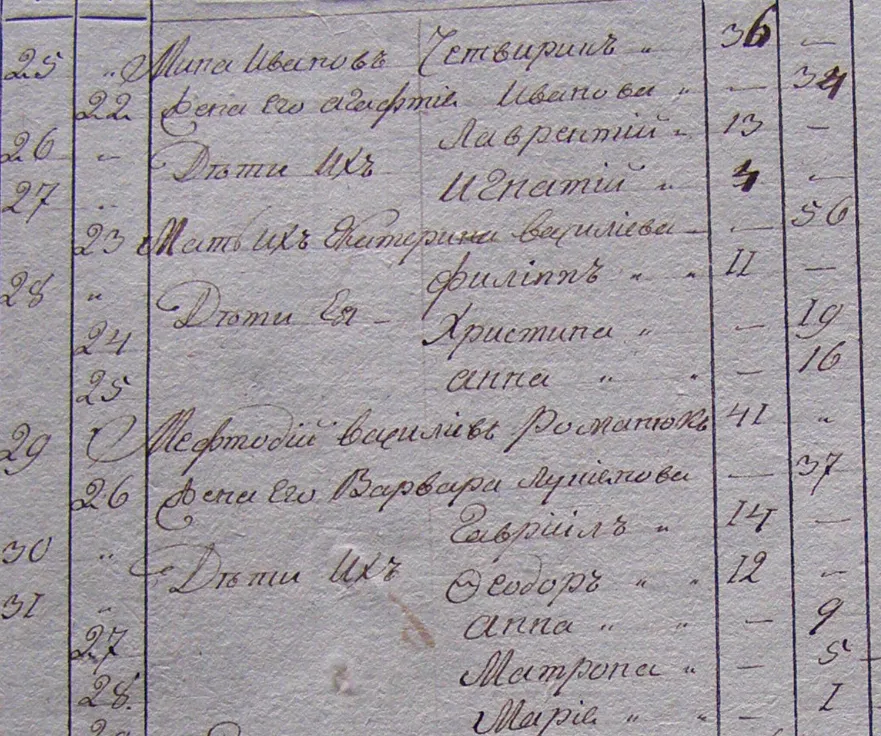
The names of the peasants in the confessional listin one of the Podolsk villages in the 1930s.
Among the names of Latin origin, the most common are Valery ("healthy, strong"), Vitaliy ("vital, viable"), Anastasia ("returned to life, resurrected"), Evgenia ("noble"). It should be noted that many names have their counterparts in the Catholic and Orthodox traditions. They can radically differ in sound, but are identical in meaning. Therefore, in ancient documents of the 19th century, you can sometimes find both variants of the name. Here are a few examples: Yuriy - George, Yaroslav - Ieronim, Yatsko - Hyacinth, Fedor - Theodore.
Many ancient Slavic names are now hard to find, or are extremely rarely chosen by parents for newborns: Boyan ("singer, storyteller"), Vsevolod ("to own everything"), Jeremiah (or Yarema; it originates from the pagan god of fertility Yarila), Miroslav ("one who glorifies the world"), Zhdan (a child whose birth was long awaited in the family).
Ukrainians also believed that the concept they put into their own name had magical power and ensured a person a happy future.
Previously, a large role in choosing a name for a newborn belonged to the priest. The choice of a name depended on the saint, whom the church honored in the days leading up to the child's baptism. The priest used a special publication - saints, which listed the names that children baptized on a particular day of the year could be named. Also, the basket with which the father came to church to baptize his newborn child could help in choosing the name desired by the parents. The more generous this basket was, the more meticulous the priest was in choosing a name. But very often the meaning of the child's name was not clear to every Ukrainian. Therefore, our ancestors tried by any means to modify the name in a Ukrainian way, more accessible to understanding. For example, Moses - Mosiy, Evseviy - Efim, Georgy - Yurko, Ignaty - Ignat.
Gradually, biblical and traditional Christian names replaced ancient Ukrainian, more pagan versions of names - Dana, Svithogora, Dobrynya, Kupava, Radomir, etc. Starting from the 15th century, the church was very meticulous about the choice of name and considered only canonical names acceptable. But Ukrainians did not want to lose the ancient traditions of their people, and therefore called their children double names: the first name was given in honor of the saint when the baptism ceremony took place, and the second - according to custom, was given personally by the father and mother. The most famous example for us in history is the name of the prominent Ukrainian hetman Bohdan-Zynovy Khmelnytsky. It is also worth mentioning Prince Yaroslav the Wise, whose church name was Yuri. Later, the Christian name began to occupy a leading place, and the folk one.
Later, names became the basis for the formation of surnames - today the lion's share of Ukrainian surnames are patronymic in origin, that is, they come from the name of the founder of the family. For example, Andriychenko, Mykytenko, Mykhalchuk, Ilchenko, Stasyuk and the like. You can learn more about the meaning of your surname by using our service research into the history and origin of the surname.