
The author of the book offered to your attention - Igor Ivanovich Smutok, is undoubtedly one of the best experts today on the nobility of Western Ukrainian lands during the period when these territories belonged to the Crown of Poland and the Polish-Lithuanian Commonwealth. His work has become the quintessence of the creative output that was formed by the scientist during many years of painstaking fieldwork in the archives. The book studies the Ruthenian (Ukrainian in the modern sense) nobility of the Przemysl land, which was characterized primarily by religious affiliation to Orthodoxy (later, in the 17th century, to the Greek Catholic Church). The Przemysl land of the times of the Polish-Lithuanian Commonwealth is a considerable region that mainly covered the territories of the Carpathian Basin within the boundaries of today's southern districts of the Lviv region and the Subcarpathian Voivodeship in present-day Poland.
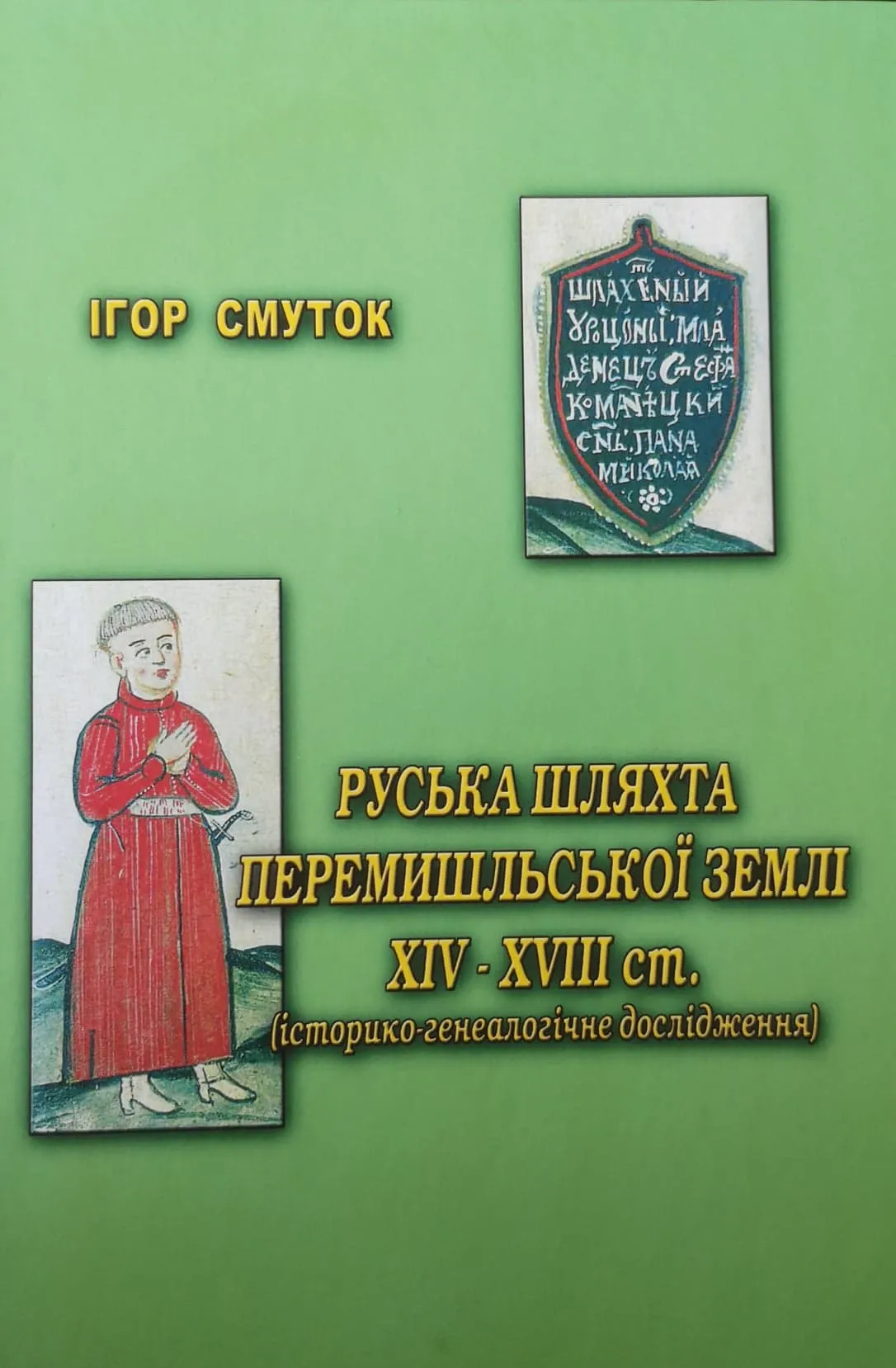
The main source base of the research is the act books of the Przemysl Grodno and Zemstvo courts, which to this day, with rare exceptions, remain unpublished and are compactly stored in the Central Historical Archive in Lviv. We will talk about this type of sources and their importance in genealogical research. more details were written in a separate article. However, the source material used in the book is not limited to the Grodno and Zemstvo acts. Ihor Smutok involved in his research documents from Polish archives, manuscripts from the library of Lviv University and the National Library named after V. Stefanyk and a number of other published and unpublished sources. Finally, a detailed review of the sources for the history of the Ruthenian nobility of the Przemysl Land, a description of their specifics, as well as a wide range of historical literature on this issue can be read in the first chapter of the book. In fact, this is a guide for those researchers who wish to independently study the genealogies of noble families from Galicia.
Structurally, the work is divided into 4 sections, if in the first the reader gets acquainted with the historiography and sources, then the second section contains an excursion into the history of the formation of the noble class of the Przemysl land in the 14th – 15th centuries. Ihor Smutok reveals the process of the formation of the noble class against the background of historical events and conflicts that took place in Western Ukrainian lands at that time, establishes the ethnic origin, property status and religious affiliation of the founders of the noble families and their descendants.
The third chapter of the book presents a collective portrait of the Ruthenian nobility of the Przemysl land in the 16th century, revealing the process of its formation as a socio-cultural group. The author is interested in such issues as demographic development, settlement, structure of the noble family, property status, and level of literacy. According to Igor Smutko, during the 16th century, the number of Ruthenian nobility increased 9-10 times. If in 1508 it was represented by 250 adult men, then in 1605 it numbered about 2,000 people. As a result, their estates turned into noble settlements, where from a dozen to several hundred people lived. Thanks to such a large population of Ruthenian noble families, many of their descendants live in Ukraine and beyond its borders today. In particular, these are the numerous Kulchytsky, Terletsky, Ilnytsky, Bilynsky, Popely and others.
As the main thesis of the author, we can highlight the statement that the Ruthenian nobility of Przemyśl is a separate socio-cultural group that in the 16th-17th centuries created a separate world that almost did not intersect with the Catholic environment. The Ruthenian nobility zealously protected its religious affiliation to Orthodoxy, did not practice marriages with Catholic families. In the 16th century, the political intentions of this group were quite ambivalent, because with rare exceptions, the Ruthenian nobility practically did not occupy high positions of government even at the local level.
The situation gradually began to change from the second half of the 16th century. In the fourth and fifth chapters of the book, the Ruthenian nobility is studied in the context of the socio-political and economic upheavals of the 16th – 17th centuries. Based on the analysis of the lists of banners of the Polish–Lithuanian Commonwealth army, the author convincingly proves that in the 16th century the Ruthenian nobility became an important source of replenishment for the Polish–Lithuanian Commonwealth military formations.
The marker that separates chapters 4 and 5 of the book may confuse an unprepared reader, because it refers to the union of 1691, after which the Orthodox bishop of Przemysl, Innokenty Vynnytsky, transferred to the Greek Catholic Church. This event actually marked the beginning of the gradual erosion of the Ruthenian nobility as a separate socio-cultural group. During the 16th century, the Ruthenian nobility became closer to the Polish Catholic noble fraternity, mixed marriages, and property transactions between Catholic and Uniate nobles became widespread. However, at its core, the majority of the Ruthenian nobility, who were characterized by a poor property situation and short life horizons, retained their Ruthenian/Ukrainian identity due to their marginal position.
Working with the book is greatly facilitated by the presence of a nominal and geographical index, without which the work on the genealogy of dozens of noble families would have been significantly lacking. The only thing missing is genealogical tables, which the author was unable to publish due to the format of the publication.
In general, a place should be reserved on the bookshelf for Igor Smutek's book about the Rus' nobility of the Przemysl land for everyone who studies the genealogy of the privileged classes of the Ukrainian lands and is generally interested in the history of Ukraine during the Polish-Lithuanian Commonwealth.