
If your ancestors come from the territories of the former Russian Empire, then the revision tales are an indispensable source for conducting a full-fledged genealogical research. They allow you to find valuable information about the family ties between your ancestors, and learn about their social status. Revision tales are special documents of the nominal census of the taxable population of the Russian Empire, which was covered by revisions in the period from the beginning of the eighteenth to the middle of the nineteenth centuries.
The term "fairy tale" comes from the word "to tell", originally it meant a record of information obtained from words. Other documents of the 18th century were also called fairy tales. For example, there were officer's tales, which were a record of the service of a particular officer. The purpose of the audit was to organize the supply of troops, because the poll tax went to maintain the army...
The emergence of Reviz tales as a special type of historical source is associated with the tax reform that was carried out in the Russian Empire in 1718. At that time, the courtyard tax was replaced by a poll tax. In other words, taxes began to be collected only from the "souls of men". Carrying out this kind of reform required a certain organization of population accounting. In the fall of 1718, the tsar issued a decree on the collection of "tales", which were to contain information about the number of souls in all settlements.
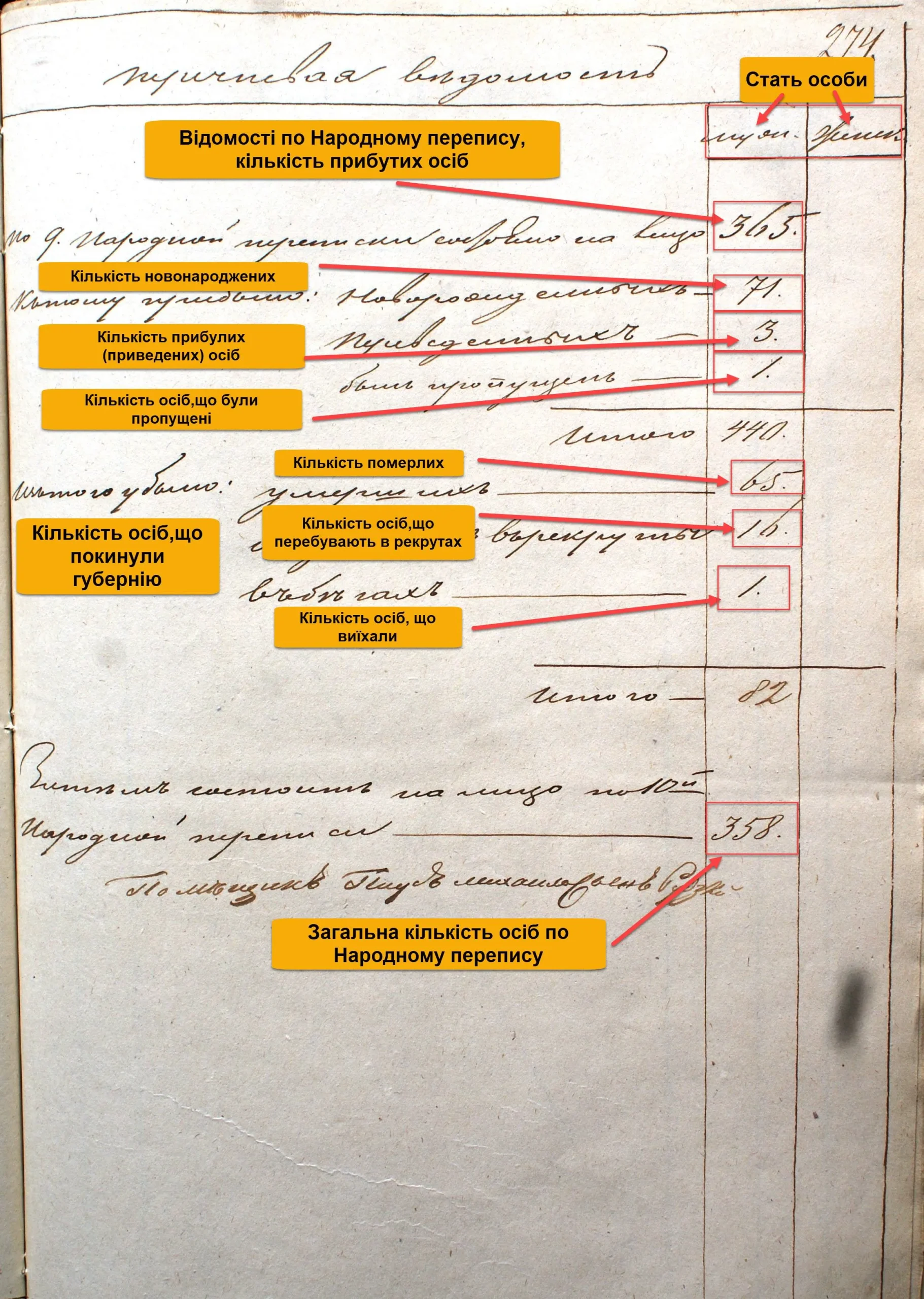
General information about the 1850 audit using the example of a village Chernelievky, Krasylivskyi district, Khmelnytskyi region
In the period from 1719 to 1857, 10 audits were conducted. The "base year" is usually considered to be the year during which the largest number of people were counted. Another feature of these documents is that searches and audits were not conducted throughout the entire territory of the Russian Empire. In the territory of Sloboda Ukraine, the first population census, conducted by the Russian Tsar Peter I, took place in 1718–1727. In Left-Bank Ukraine, the first population audit was the fourth census, conducted in 1781–1787, because only at the beginning of this period did Left-Bank Ukraine finally lose its autonomy. In Right-Bank Ukraine, the first was the fifth population census (audit), conducted during 1794–1808, because its accession to Russia took place in 1793–1795.
It was from that moment that the history of Reviz tales began. All ten documents were drawn up in the form of a notebook or book, which contained information about the family status and statistics of the population by gender, nationality and social composition, as well as geographical location. The issue of population migration is also touched upon here, as even information was indicated about runaway peasants or those who moved to other landowners. When studying these documents from the point of view of genealogy, the most important are data relating to the composition of the family and family ties within it, as well as the dates of birth and death of all family members, information about marriages and dates of divorces. When carrying out such censuses, the received records were divided by counties separately for each category of taxable population. In these records, you can get information about the owner of the farmstead - name, patronymic, surname, social status, age according to the past and current census (it is interesting that age was often indicated approximately), as well as information about relatives living with him - wife (sometimes in early censuses - with maiden name), sons (necessarily age according to the past and current census), daughters, sometimes brothers with families, parents, etc. In some revisions, in particular the first, second and sixth, female persons were not recorded. In the records, you can often find notes about the absence of some persons during the census - in recruits, runaways, resettled, etc. In some revisions, nationality and even physical defects were also indicated. Most of the Reviz tales are kept in the state archives of the regions, in the funds of county courts, treasuries, or in the collections of provincial treasury chambers.
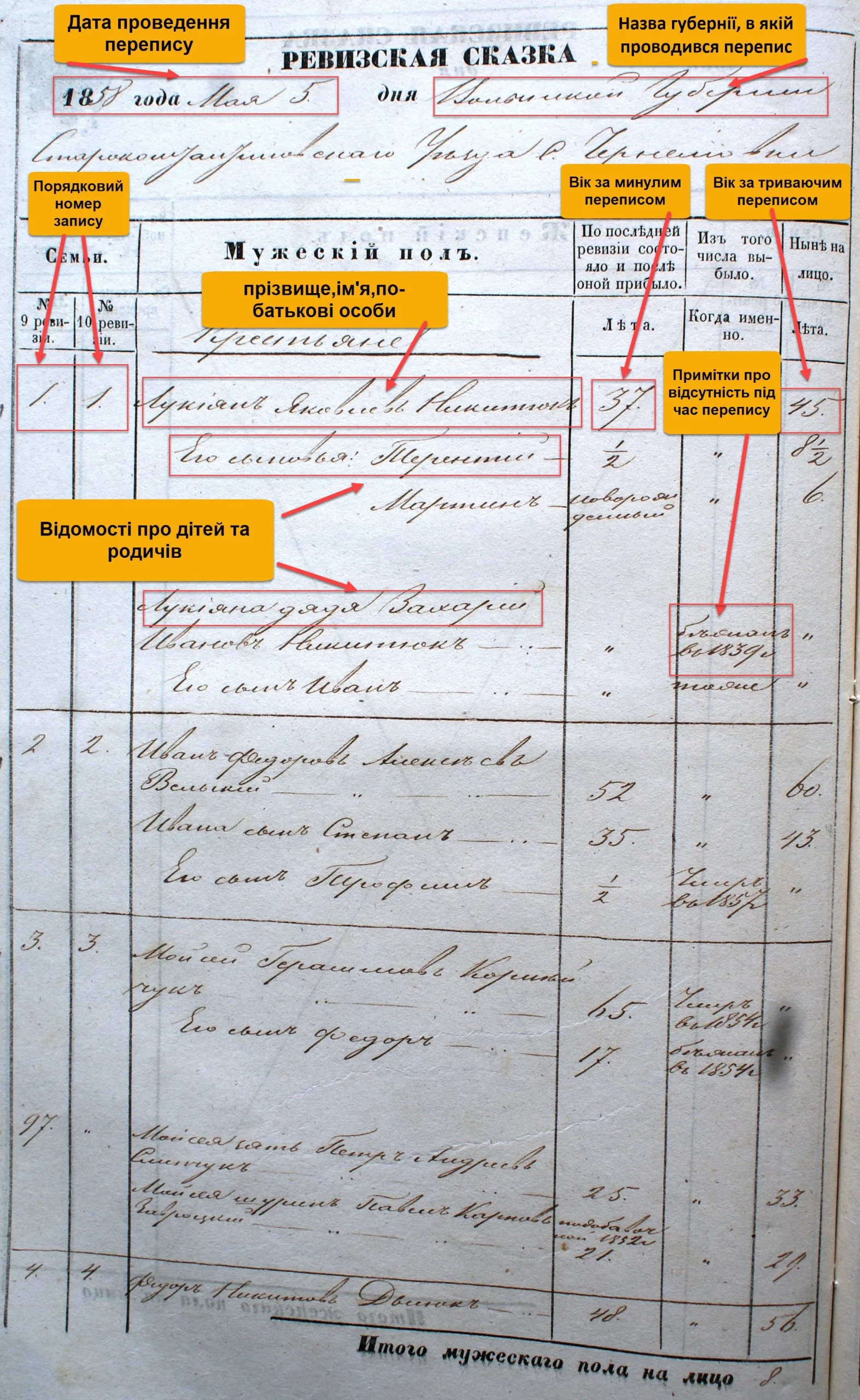
The structure of a typical recording of a Reviz fairy tale from the mid-19th century.
The reviz tales were compiled as a single document for a specific settlement or part of it (if, for example, there were several owners in the village). The title necessarily indicated the date of the census and the person who conducted it (landlord or headman), as well as the secretary. In the reviz tale of the landowner peasants, the owner was indicated - his full name and rank.
Entries in the audits were made by household, which allows us to establish when a particular family split up. The head of the family was recorded first, followed by a list of all his relatives, indicating the levels of kinship.
Each audit consisted of several stages, as a result of which special types of derivative documents appeared. However, the primary material for the audit was the audit reports themselves. The next stage was generalization, structuring and thorough verification. Then the audit reports were sent to local authorities, where the first stage of data generalization on a county, provincial or guberniya scale began, which consisted of comparing the data of the current audit with the results of the previous one. The result of the census was the compilation of general time sheets and payroll books (starting with the fourth audit).
Work with revisions is based on studying the entire array of records preserved for a particular settlement. In this case, it is necessary to study revisions that are close in time, since each such census refers to the previous one, and if one of the revisions is skipped, important details may be missed (for example, information about the circumstances of the departure of a person or family from the village).
Reviz tales are usually bound in large volumes, of which there can be several dozen per county. In some archives, these volumes are listed by settlement or owner, so you can go straight to the desired village, in others, you have to look through the entire county to find the desired settlement.
It is worth considering that a fairly significant part of the population in the Reviz tales does not have surnames. In this regard, when moving from sources of a later period to the study of Reviz tales of the 9th-10th revision, it is desirable to know not only the name, but also the patronymic of the head of the family, taking into account his age, because, for example, there may be several dozen Vasils in one village.
When conducting genealogical research in the Reviz tales, you can find the necessary information about your ancestors, learn their names, social status, marital status, dates of birth and death. These invaluable documents are an informative and significant source for studying the history of peasant and merchant families who lived in the period from the beginning of the 18th to the middle of the 19th centuries in the Ukrainian lands that were part of the Russian Empire.