
The work of a genealogist is greatly facilitated by sources that allow for a kind of cross-section of the family composition as of a certain year. Usually, confessional lists or revision censuses (for the period from 1795 to 1858) are well suited to the criteria of such a source. However, for the territories of the former Russian Empire, there is a specific source that allows for detailed clarification of the composition of the family as of the end of the 19th century. We are talking about the census sheets of 1897.

The idea of conducting a census had been developed in Russia since the early 1880s, but it was only put into practice in 1897. No such censuses were subsequently conducted in the Russian Empire. The purpose of the census was to determine the size and composition of the empire; all residents of the state, without exception, were subject to a general census.
Each census form was drawn up for a separate household. The address was entered on the title page, and the inside part was devoted to the characteristics of each member of the family or household. There were 3 key forms of census forms - A, B, C. Peasant households were entered in form A, non-peasant households in rural areas in form B, and urban residents in form C. There were also separate forms of census forms for military personnel, prisoners, monks, and closed educational institutions.
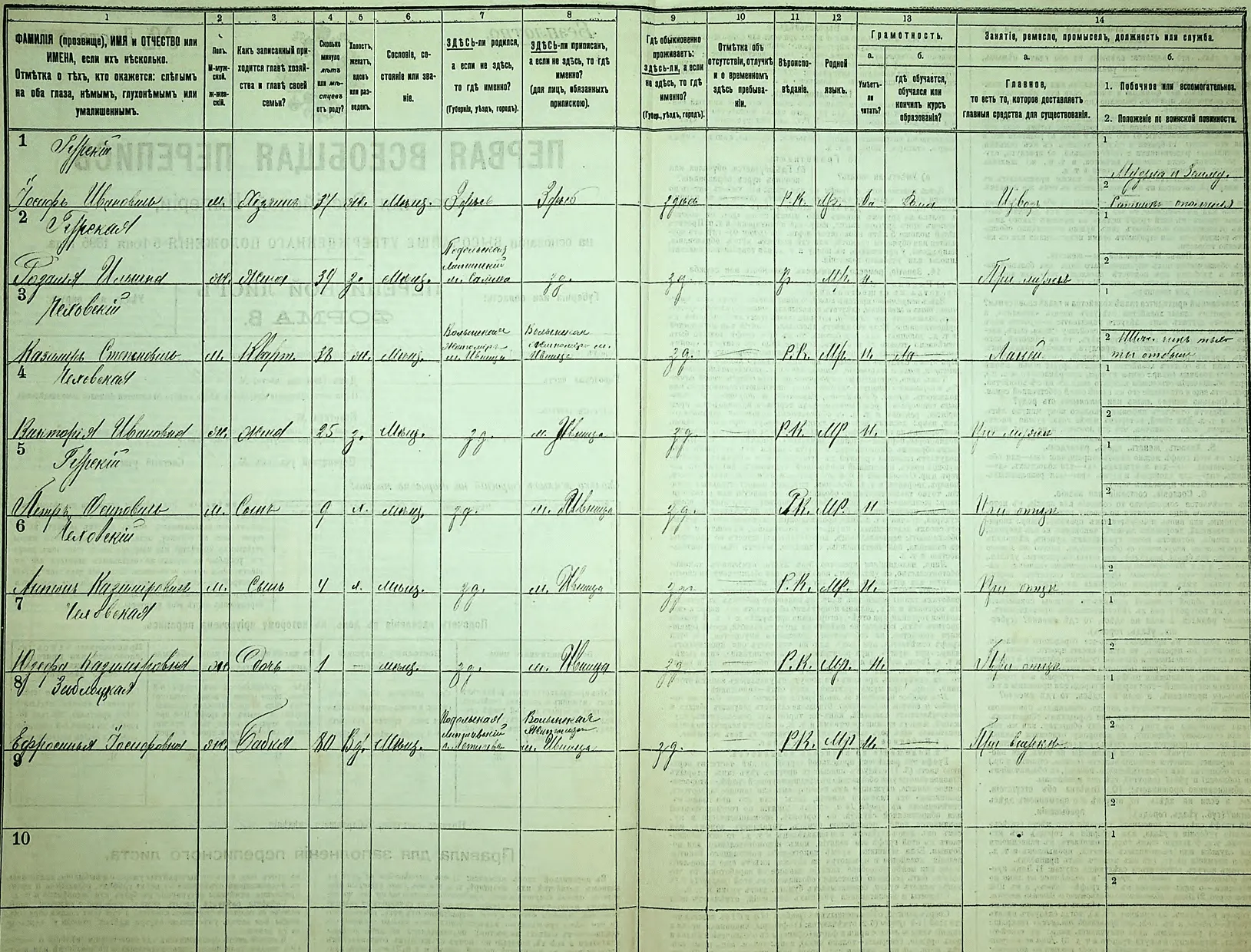
Sheet from the 1897 census of the town of Khodorkov, Skvirsky district, Kyiv province
So, what information was contained in the census forms?
Information about the owner of the yard or house, the number of residential buildings in the yard, a description of the house itself. Usually the language of the census here is laconic, as a rule we find mentions of a wooden hut covered with straw
The most informative part of the census form is the form in which information about the family members of the owner of the yard, or its residents, was entered. There were as many as 14 columns here, and up to ten family members could be entered on one sheet. The content of the census form questionnaire was as follows:
1. Surname, first name, patronymic. Here it was also necessary to indicate if the person had certain defects or characteristics - was blind, deaf-mute, or insane.
2. Gender of the person.
3. What relationship the person has to the landlord. First of all, it was about family ties - wife, son, daughter, brother, nephew, etc. However, if the landlord, for example, had tenants living with him, they were recorded together with the landlord's family members, noting that they were tenants.
4. The person's age at the time of the census.
5. Marital status of the person – married/single, widowed/widowed or divorced/divorced
6. The person's social affiliation and rank, if any. This referred to membership in the main strata of the population – peasants, burghers, nobles, merchants, Cossacks, or clergy.
Columns 7-10 related to the person's place of birth and residence.
7. Place of birth of the person – this column is very informative when genealogical searches fail to establish the origin of family members, because if the person was not local, then the place of birth was recorded.
8. The same applied to registration. Sometimes a person could live in a new place for years, while remaining registered somewhere far away.
9-10. Where a person usually lives and a note about their absence – the opposite situation, when a person was registered in a settlement, but lived in another, or went away seasonally for some trade or work. Such situations were also reflected in the census.
11. Religion – belonging to one of the religious denominations: Orthodox, Roman Catholic, or Jewish.
12. Native language – for most residents of Ukrainian provinces, Little Russian was noted, by which they meant the Ukrainian language.
13. Literacy – this column noted whether a person could read, and if so, where exactly they learned to read – at home, in a parish school, or some other school.
14. Occupation, craft, trade, position. The main occupation, that is, the one that provided the main means of subsistence, as well as additional occupations, such as seasonal work at a sugar factory, were separately noted. This column also recorded the relationship to military service of men.
After the census, general statistics were compiled, which were published in separate volumes for each province - this is invaluable material for historians and demographers, but this publication is of little practical use for a genealogist, since it does not contain the census forms themselves. The 1897 census forms themselves have been poorly preserved. This is due to the fact that the original census materials, which were taken to St. Petersburg for statistical processing, were soon destroyed.
In some places, second copies of census sheets have been preserved in local archives. The situation looks best for the Kyiv province - census sheets have been preserved for most settlements, including Kyiv. Today they are stored in the State Archives of the Kyiv region. Many of these documents have been digitized and are available online. Census sheets have been partially preserved for the Odessa region. The situation is much worse for other Ukrainian provinces - only fragments have survived and there are no separate census funds for, say, the Podolsk, Volyn, Poltava, or Katerynoslav provinces.