
In our genealogy blog, we decided to launch a new thematic section with reviews of interesting books related to genealogy, local history, and certain aspects of Ukrainian history. These books will help in researching your family tree or broaden your horizons of knowledge about your family history against the background of the history of Ukraine or certain of its regions.
The first book with which we will begin such a review is Martin Pollak's work "To Galicia. About Hasids, Hutsuls, Poles and Ruthenians. An Imaginary Journey through the Vanished World of Eastern Galicia and Bukovina." The book was published in Ukrainian translation by the "Books - XXI" publishing house in Chernivtsi in 2017.
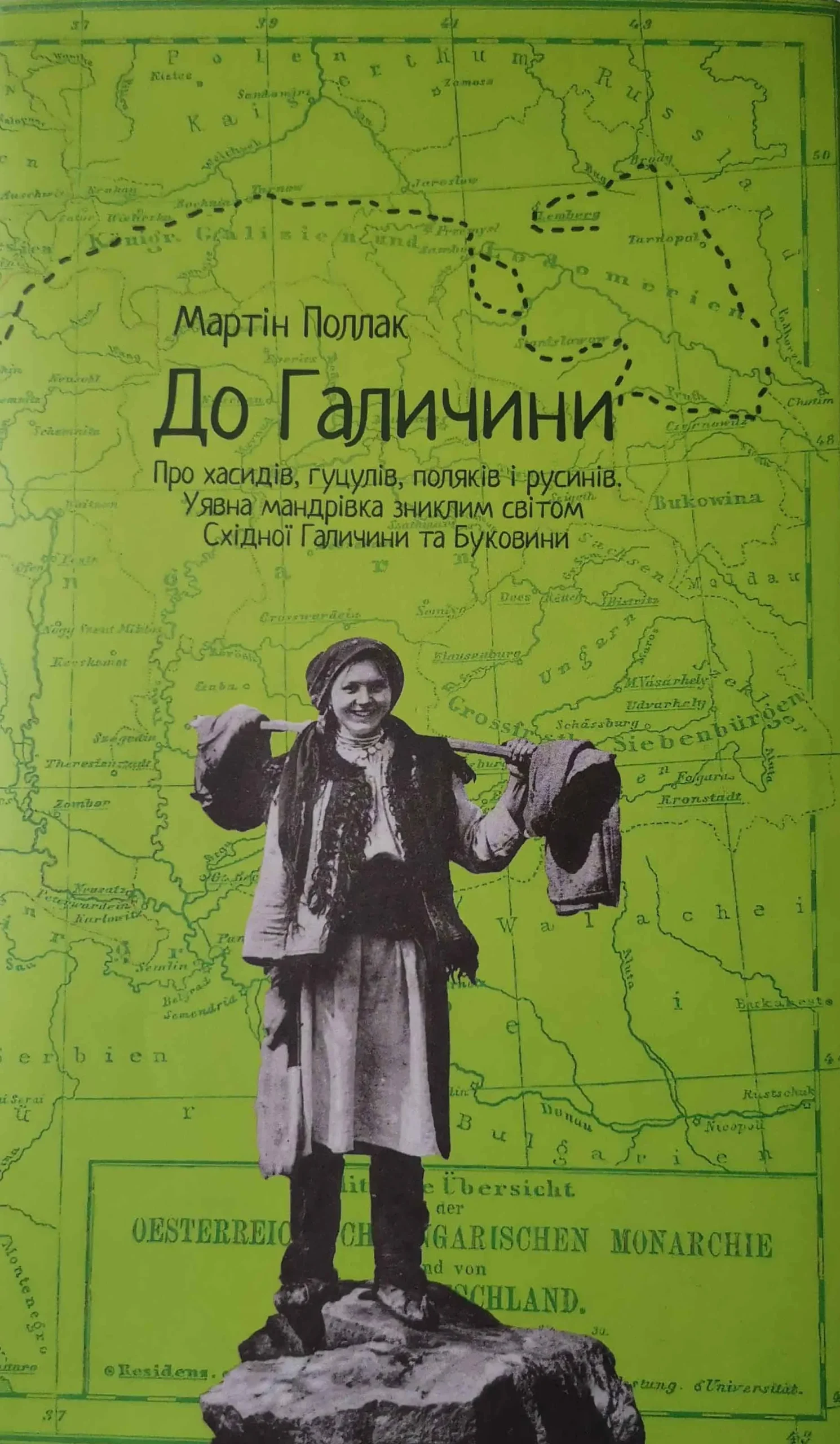
Martin Pollack is an Austrian writer, publicist, journalist, and translator. He wrote his most famous works back in the 1980s, but these books have only recently reached Ukrainian readers. One of Pollack's best works is the book "To Galicia." As the title itself says, the author invites the reader to immerse himself in an imaginary journey through Galicia and Bukovina. Pollack's route is laid primarily by railways, and this is not surprising, because it was the railway that made Galicia closer than ever to Western Europe and to the metropolis itself - Vienna, in particular. The railway provided opportunities for the rapid development of the mining and chemical industries in the Carpathian Mountains, and caused the emergence of such a phenomenon as the "Galician Pennsylvania." Railways shortened distances, improved communication, but ultimately did not make the motley people of this region richer.
From the train windows, together with the author, we observe the outlines of not only the larger cities of Galicia, including the capital Lviv or Chernivtsi, but also small provincial Galician towns with their Jewish shtetls, villages, and the most remote corners of the region - such as Brody or Zalishchyky.
If today tourists visiting Lviv have an idea of the candy-scented grandmother Austria, under which everything was fine in Galicia, people lived affluently and loved the emperor, then Martin Pollak presents a more realistic picture, which sometimes strongly contradicts the myth of cloudless Austrian times. Galicia appears before us as a poor, economically and culturally backward, deaf and the most remote corner of the Habsburg empire. We see the dirt and swamp of village and city streets, the incredible poverty of the local population, terrible living conditions, an incredibly low level of literacy and education among the population. The author describes the scope of administrative arbitrariness, corruption, police corruption, political elections that degraded to the level of farce, when democratic candidates were deprived of the right to vote, and pre-election meetings were dispersed with bayonets.
At the same time, the ethnic polyphony of the region, which was made up of Ukrainians, Poles, Jews, and Germans, is depicted in bright colors. Among them, we also see various social and ethnic types of Boykos, Hasidim, Austrian officials, burghers, migrant workers, and industrialists, who formed the colorful mosaic of the region and its identity.
In creating his book, Martin Pollack relied primarily on German-speaking authors and newspapers, the memoirs of Germans and Austrians who once lived in or visited Galicia. This is the material that Ukrainian researchers of 19th-century Galicia rarely reach for due to their lack of knowledge of the language. At the same time, the sources used by Pollack allow us to look at Galicia from the perspective of the metropolis, as well as the Austrians, who after 1918 perceived Galicia as a lost world, part of a lost empire.
The journalistic style of the story makes the book especially interesting and easy to read. Here we find vivid sketches of the everyday life, crafts, and trade of Galicians. The descriptions of the industrial regions of Galicia, in particular oil enterprises and the difficult conditions of everyday life of workers, are interesting. Who would have thought today that at the turn of the 19th and 20th centuries, Galicia ranked 4th in world oil production after the USA, Russia, and India. Some oil wells or mineral wax pits literally made their owners millionaires overnight.
The passages from the life of the peasants are vivid. The modern reader cannot help but be struck by the scale of poverty in which a typical Galician village languished. Poor peasants walked barefoot until the autumn frosts in order to preserve their shoes. Often a family had one pair of boots for the whole family, the basis of the diet was oatmeal, porridge, potatoes, cabbage, beets, and meat was eaten only at Christmas and Easter, or for a wedding or funeral. Such poverty often pushed Galician peasants to seek employment overseas, but even here they became easy prey for emigration agents, who swindled the peasants out of their last funds, promising them wealth in overseas lands, which the emperor of America was ready to share with all newcomers.
The book "To Galicia" will best allow the reader to feel the true spirit of the era, as well as to gain a more objective idea of the life of Ukrainians in Galicia at the turn of the 19th and 20th centuries.