
To fully engage in genealogical research, it is not enough to read birth records and compile genealogical tables well. No less important is knowledge of the historical context against which the generations of the family under study changed and their social status. In view of this, the genealogist must deepen his knowledge of the history of a particular region, understand the peculiarities of social hierarchy and class affiliation.
Since Ukrainians are a nation that emerged from the village, and in 90% our ancestors were peasants, it is very important to understand what the peasantry represented in ancient times. The proposed book by Professors Oleksandr Gurzhiy and Vasyl Orlyk allows the reader to better understand the peculiarities of the legal and social situation of the Ukrainian peasantry in the 18th-19th centuries.
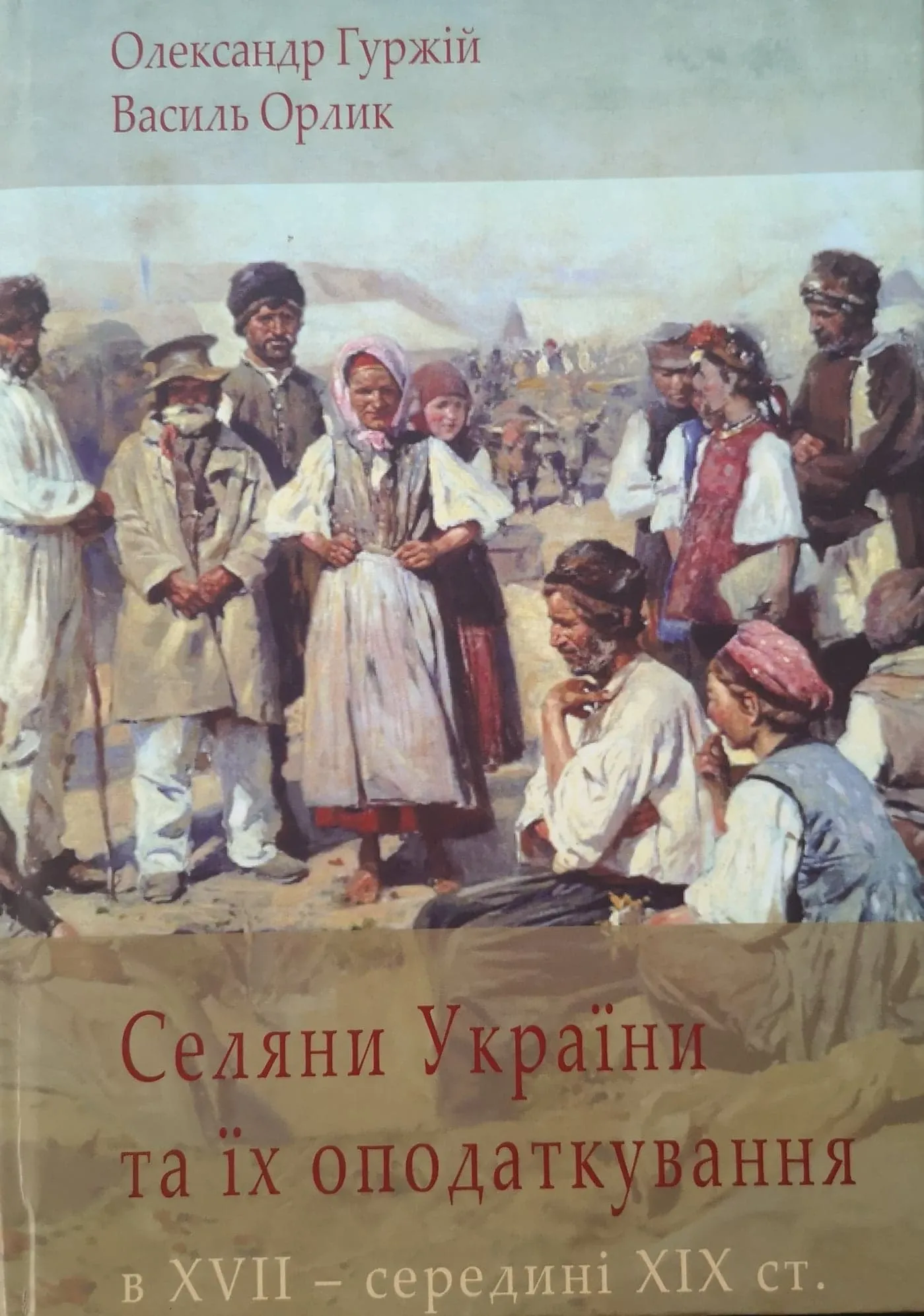
Chronologically, the book covers the times of the Hetmanate - from the second half of the 17th century and brought to the middle of the 19th century. During this period, large-scale geopolitical changes took place on the Ukrainian lands - the Cossack state created by Bohdan Khmelnytsky during the 18th century gradually lost its autonomy in favor of the Russian Empire, which eventually completely incorporated the Ukrainian lands by the end of the century, equalizing their social and legal status with other provinces of the Russian Empire. These processes are considered in the book in the context of the changes that the Ukrainian peasantry underwent in its social and legal status, until the formation of the two main, most numerous categories of the rural population of Ukraine was completed in the first half of the 19th century: state and landlord peasants.
The authors of the book tried to cover all the lands of modern Ukraine with their research. Indeed, a deep analysis of the social situation of the peasantry and the state's tax policy regarding this situation in the territories of sub-Russian Ukraine was conducted. However, the book also contains an attempt to carry out a cursory review of the peasantry in Western Ukrainian lands, which seems unnecessary, since the authors relied on a weak source base and were unable to fully describe the situation of the peasantry there and its evolution under the rule of the Polish-Lithuanian Commonwealth and the Austrian Empire.
The authors based their research on a powerful source base - starting from the hetmans' universals and collections of Russian legislation, ending with a huge layer of unpublished documents from the Central Historical Archive in Kyiv, regional archives of Ukraine, and Russian archives.
The first chapter of the book reveals the individual social groups and categories of the rural population in the 17th-18th centuries. Today, one can encounter a stereotype that Ukrainian peasants before the reform of 1861 were entirely enslaved serfs. Reading the book by Oleksandr Gurzhiy and Vasyl Orlyk, we understand that the peasant environment of Ukraine until the middle of the 19th century was quite stratified, especially when it comes to Left-Bank Ukraine. In addition to the enslaved population, there was a considerable layer of free Cossacks. Cossacks, as a separate social category, existed in the Russian Empire until the revolution of 1917. An intermediate position between Cossacks and serfs was occupied by state (state) peasants. We should add that during the Zaporozhian military state, with the apparent freedom of the vast majority of the rural population, there was a spectrum of its own specific categories of peasants - monastic, private, rank, magistrate, town hall, free military, slobodyans, beggars, neighbors' scoundrels, etc. The authors of the book try to understand the specifics of all the listed categories of peasantry and their evolution. Of particular interest is the process of enslavement of free peasants and yesterday's Cossacks - in the book we actually find an explanation of why some defended personal freedom, while others were turned into serfs.
The book tells not only about the situation of peasants, but the subject is primarily their taxation, the state's tax policy towards the rural population and a comparison of its regional characteristics. This issue is covered in the second chapter of the book. Writing about regional characteristics, the authors compare the specifics of the situation of peasants in Southern Ukraine, Slobozhanshchyna, Right-Bank Ukraine and the former Hetmanate, because differences were noticeable everywhere.
The book introduces us to the peculiarities of tax policy towards peasants and tax administration. The activities of treasury chambers and audit practices are analyzed. Every genealogist knows how important Reviz tales as a historical source. Instead, we now have the opportunity to better understand the historical context of the audits on Ukrainian lands within the Russian Empire. The specificity of the poll tax system itself, which was practiced in the Russian Empire, is important here. It actually established a circular guarantee of the community for the payment of taxes and made it impossible for peasants to move freely.
The final third chapter of the book analyzes the bodies that were involved in the taxation of the rural population. Here we get acquainted with the specifics of the activities in this area of the courts, police, treasury chambers, village and volost councils, etc.
The main thesis of the book is that the state tried not to burden itself with the creation of special tax bodies, the maintenance of which is quite expensive, instead the main work of taxation was entrusted to self-governing rural and urban structures and to landowners. At the same time, the taxes collected from the peasants were mostly not directed to the good of society, but mainly went to the bureaucratic apparatus, the Romanov court, the military and naval departments, and financed the military policy of the Russian Empire.