
The burial rite is a ritual that has been formed over many centuries and has always had a magical character. In each historical period, funeral traditions have changed, and therefore the attitude towards death and its understanding have acquired new features over time. The burial ritual appeared in Ukrainian culture much earlier than, for example, the rite of baptism or wedding. Information about death is also a necessary component of genealogical research. After all, priests in churches traditionally, along with birth and wedding books, necessarily kept a metric book of deaths. In this article, we will focus on the main ceremonial and ritual actions in Ukrainian culture related to burial and death.
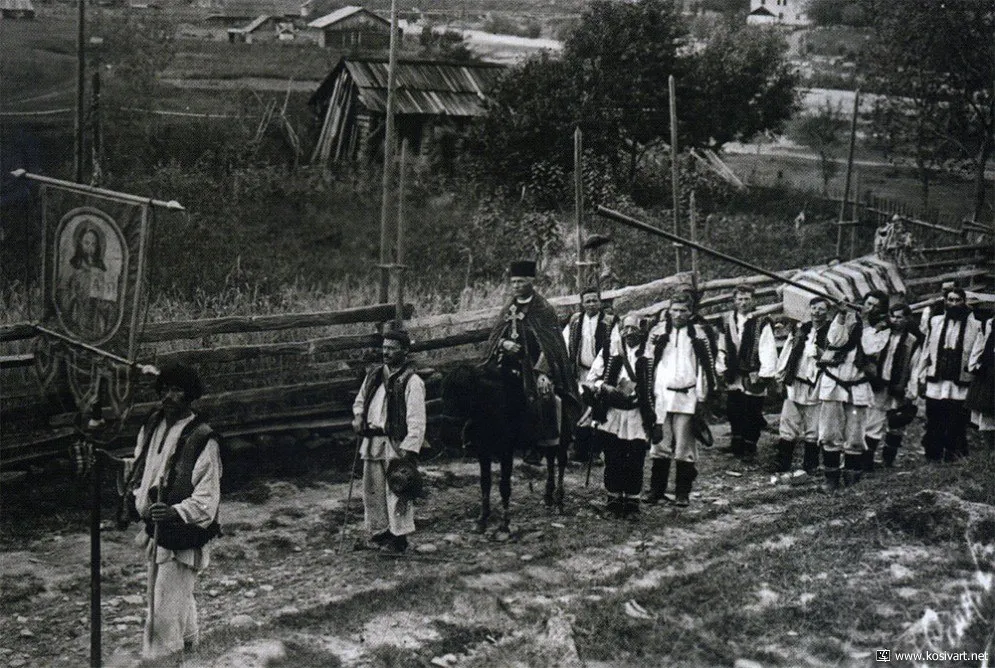
Funeral in the Hutsul region
During certain historical eras, the funeral rite was carried out in different ways. In the archaic period, the ritual of burning and sacrifice was widespread. A person was burned on a fire, and often, along with her, her relatives and household items and jewelry, often animals (especially horses). Ancient peoples believed that these things would be useful to the deceased in the next world. The Scythians, for example, necessarily buried a husband with his wife, because they believed that the soul would wander alone and would not find peace after death. From that moment on, the Ukrainians began to honor the symbol of the home hearth as a place where the souls of the deceased rest. A common phenomenon was the use of the trunk of an old tree instead of a coffin. The ancestors believed that a tree is a place where the soul resides. There was also another option: the body of the deceased was sewn into the corpse of a totem animal, hung on a tree, and waited for the birds to "carry" the person to the kingdom of the dead. Based on this ritual, the Ukrainian people came to believe that when birds return from warm lands, they bring the souls of the dead. The astral cult testifies to similar traditions: if a star falls in the sky (as the embodiment of a human soul), a person dies.
Over time, the cremation rite acquired more cultural and, to some extent, magical features. The deceased was not simply burned on a pyre, but was transferred, together with all the ritual objects, decorations and sacrifices, to a special boat, which was later set on fire and set afloat on the river. Such a burial rite formed the basis of Ukrainian beliefs about the river as a leading road between the kingdom of the dead and the living.
In Kievan Rus, there was also a ritual of purifying the soul with fire and sending it to Vyry (Paradise). A prince or a commoner was placed in a boat and clothes, household items, tools, weapons and livestock were placed next to it (a horse belonging to the deceased was necessarily killed). The boat, together with the deceased and all ritual items, was placed on firewood from a sacred tree (birch, oak or linden) and set on fire. Medieval peoples believed that the stronger the smoke from this flame, the sooner the deceased would have a path to the kingdom of the dead. When this ritual was completed, a large burial mound was built over the place where the fire had burned. This mound symbolized the heavenly path and the connection with the heavenly world.
During the Trypillian culture, the cult of the earth was widespread, and the deceased began to be buried in the ground. The Trypillians believed in the magical powers of the earth and believed that the souls of the dead were spirits of forests and fields. During this era, special wooden coffins began to be created. During archaeological excavations of ancient burials, the remains of such coffins were found. It can be seen that such burials were still connected with more ancient traditions, because the coffins were made in the shape of birds, which seemed to carry the dead to another world.
Usually the burial ceremony was carried out in sacred places for the Trypillians - groves, fields or forests. An egg-shaped mound was built over the deceased (as a symbol of birth), then decorated with yellow flowers and sprinkled with sand. Such elements of the burial testified to the belief in rebirth and return to the living world. The Slavs had a tradition of giving a newborn child the name of a deceased ancestor, because they believed that a new person in the family was a continuation of the lineage and embodied the soul of those relatives who were no longer alive.
In the 19th century, researcher T. Dovgyrda discovered a connection between ancient graves and the symbolism of Ukrainian pysanka. He analyzed the ornaments made on pysanka and found similarities between these symbols and those depicted on prehistoric burials. The construction of large burial mounds, on which new dead were later buried, was also widespread. Some scholars believe that such a burial rite formed the basis of mountain worship.
Also during the burial ceremony, our ancestors held a feast (in the modern version - a wake). The feast was considered a pagan sacrificial meal, which was held on the grave of the deceased, where they ate koliva - wheat or barley porridge, which was considered the food of the dead. At first, this meal was calm, even joyful in nature (sometimes it became an ordinary feast) and then turned into a rite of scaring death away from other members of the family.
The Trizna was repeated several times. Traditionally, such commemorations were held on the ninth and fortieth day, then on the anniversary of death, and this also continued during memorial holidays that were associated with pagan spirits - Rusaliya, Dead Easter, honoring the Spirits of Water, Earth, etc. Today, this ritual continues to be repeated: families go to the graves of their relatives, clean and arrange a ritual feast. Also, on the 9th day, they bring a novena to the church - cheese, cheese, butter and peas. The custom required bringing kolachi every Sunday for six weeks in order to honor the soul of the deceased, and after the next 3 months and a half to put a ritual dish on the grave.
Modern funeral rituals, despite the influence of Christianity, have retained many pagan features. For example, washing the deceased with water and the custom of placing a vessel of water near the deceased are associated with the pagan cult of water. Veneration of fire is observed in the custom of lighting a candle near the deceased, giving a candle in their hands. An interesting tradition is that if for some reason the deceased was not given a candle "in the other world", two candles were placed in the hands of the next deceased (as if in order for him to pass this candle on to the previous deceased relative).
The pagan cult of plants and trees is also observed in the process of choosing a coffin. If a girl died, she was usually placed in a coffin made of viburnum, if a woman - in a coffin made of poplar or spruce, and if a boy died - the coffin was made of sycamore or maple. Fields, forests and groves became sacred places for our ancestors, and on images of family trees near flowers or leaves they put a special cross, symbolizing death. Such traditions have come down to us since those times.
There was a separate tradition of "farewell" to the deceased from the house in which he lived. The dead person was necessarily carried out with his feet first so that he would not turn back. At the moment when the deceased was carried out of the house, the coffin was necessarily knocked three times on the threshold, in order to inform the afterlife that a new person was going to the world of the dead. The coffin was often lowered into the grave on a cloth or towels, this also symbolized his path to another world.
The burial ritual itself changed over time and also depended on the person's age, gender, occupation, social status, and cause of death. It was important how the person died: peacefully or in agony. If the person died hard, it meant that during his life he had a connection with evil spirits and could harm others. To prevent this harm, various magical rituals were performed: the stove was drilled, the shutter in the house was burned, or the bells were rung. A lit candle, which had previously been consecrated in the church on Maundy Thursday or Holy Thursday, was placed in the hands of a person who was dying hard, and coins were used to cover his eyes (if this person looked at someone, the other person could die). Sometimes this was considered an incomplete ritual, so an aspen stake was driven into the deceased's chest, poppy seeds were sprinkled on his eyes, and stones or garbage were covered so that the deceased would not cause any harm to his loved ones.
A common tradition was to bury unmarried boys and girls in wedding attire, with bouquets, which symbolized the wedding with the earth. Sometimes the funeral rite contains elements of a housewarming or birth (the coffin is considered a new home or cradle). When a Cossack was buried, his eyes were covered with a red Chinese cloth. And now there is an opinion that in pagan customs the deceased were dressed in red clothes, which was considered a symbol of death.
In the modern world, the dead are prepared for burial according to established traditions. They are washed and dressed in new clothes, the elderly usually in dark-colored clothes (Boyks and Hutsuls, on the contrary, dressed the deceased in white clothes and wrapped them in white cloth). Women are usually buried without jewelry, their heads are tied with a scarf and a cap is worn. Men are buried without a headdress, but a cap or hat is always placed in the coffin.
The deceased was always accompanied to the cemetery by a funeral procession. A cross was carried in front of the deceased, followed by the coffin, and then followed by relatives and other close and familiar people. In ancient times, a bowl with a koliva was carried in front of the coffin and cattle were led. Three clods of earth and money were thrown into the grave. The burial ceremony ended with the eating of koliva near the grave, which symbolized the unification of all the living.
The burial ceremony is a unique ritual that unites generations of living people to honor the memory of their loved ones. The place of remembrance is also cemetery, which, incidentally, is an important source of genealogical research. Over the centuries, many traditional symbols and customs that came to us from paganism have been preserved, but they have changed and acquired more cultural features. The peculiarity of the religious and ideological ideas of the Ukrainian people was that the death of a person was not considered an irreparable tragedy, it was not customary to cry for the deceased. It was perceived as a temporary departure to another world for a future return, in the form of subsequent generations and descendants.