
Yuriy Lehun's book is undoubtedly a must-read for anyone interested in Ukrainian genealogy. Despite the fact that the monograph was published in 2005, Ukrainian historiography has not yet seen a more systematic analysis of the sources of genealogical research. The territorial framework covered in the book concerns only the Podolsk province. However, it will be useful for researchers of family genealogy from other areas of the former Russian Ukraine, since the set of sources described by the author is typical for most provinces of the Russian Empire.
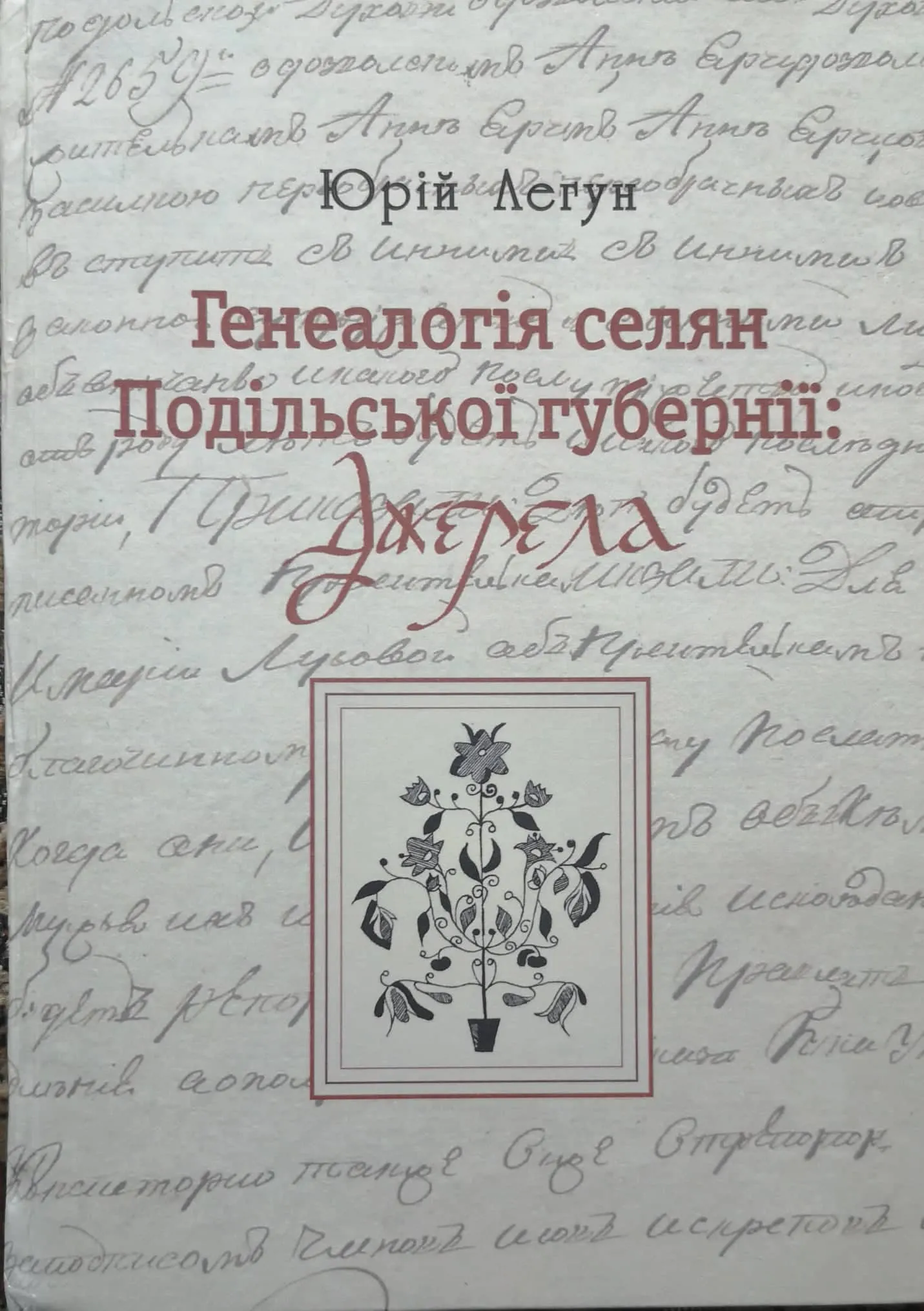
Yuriy Lehun's work is divided into six chapters. The historiography review contains a valuable list and analysis of works in the field of genealogy produced by Ukrainian, Russian, and Polish researchers up to 2005. Russian historiography clearly dominates here, but over the past 15 years, many new books and scientific articles have appeared in the field of Ukrainian genealogy, and the general public's interest in genealogical research has significantly increased.
The following chapters of Y. Lehun's book concern a certain type of genealogical sources – church, state-administrative, economic-financial, and judicial-police origins.
The corpus of documents of church origin is perhaps the most massive. It is also invariably popular with genealogy researchers, because metric books belong to this group. Yu. Lehun traced the evolution of metrics from the moment of their appearance to the revolutionary events of 1917-1921, and also analyzed the condition and places of their preservation. For different regions of historical Podillia, metric sets are presented differently. In some places, the situation is satisfactory: metric books and confessional inscriptions, although with gaps, have nevertheless been preserved from the end of the 18th century to the beginning of the 20th century. At the same time, there are areas where metrics are absent altogether. For example, metric books are missing for many villages in the Haisyn or Teplytsky districts of the Vinnytsia region. In such cases, one should look for related sources.
The third chapter of the book describes the materials of the state administrative registration of the population of the Podolsk province. Here, attention is paid to the revision censuses that were conducted in Podolsk from the end of the 18th century to the 1850s. These sources can replace the metric books, in case of their absence. The author also emphasized the documents related to the military service of Podolsk peasants. Yu. Legun not only analyzes the forms of documents and their evolution, but also tries to establish the state of preservation of the sources and the archival collections in which they are stored.
The fourth section of the book concerns genealogical information in economic and financial sources. This section seems especially important for genealogy researchers. After all, even a beginner knows about metric books, but how to supplement the information in these basic sources, or what to replace them with in their absence, is a more difficult question. The author analyzes such documents as estate inventories, serfdom accounting books, charters, village council decisions, collective complaints of peasants, tables of calculation of manor and field lands, lease agreements and land purchase and sale agreements, etc. The analysis of these documents is not so difficult as their search, because for the most part they were not deposited in archival collections as separate funds. Since hereditary land ownership prevailed in Podillia over state ownership, economic documentation of villages must be sought in funds of private origin in the archives of Ukraine, Poland and Russia. All this requires special knowledge and skills, and the algorithm for the corresponding search is precisely given in Yuriy Lehun's book.
A separate section of the monograph reveals the potential of materials from judicial and police institutions in genealogical research. This is another group of sources that is rather poorly used by genealogical researchers. Often such documents are not systematized and it is difficult to find the right family in them, especially if the archival cases are in whole complexes for a separate county. At the same time, in the materials of judicial and police institutions one can find descriptions of the appearance of persons, individual character traits, everyday life and even direct expressions of the subjects.
The book "Genealogy of Peasants of Podolsk Province" gives an understanding that for thorough studies of the history of the family, field research alone is not enough. A complex of knowledge about genealogical sources is needed, familiarity with at least the basic historiography of genealogical research. All this will allow the researcher to maximally expand the horizons of the potential study of the genealogy of the family and set a direction for movement where the situation would seem hopeless.