
In most cases, genealogical research in Ukrainian realities does not go back further than the 18th century. Surely every genealogist has wondered whether it is possible to overcome this threshold and study one's lineage several centuries deeper? Is it possible to somehow compensate for the lack of birth records, which began to be kept on a large scale in Ukrainian lands only in the last quarter of the 18th century?
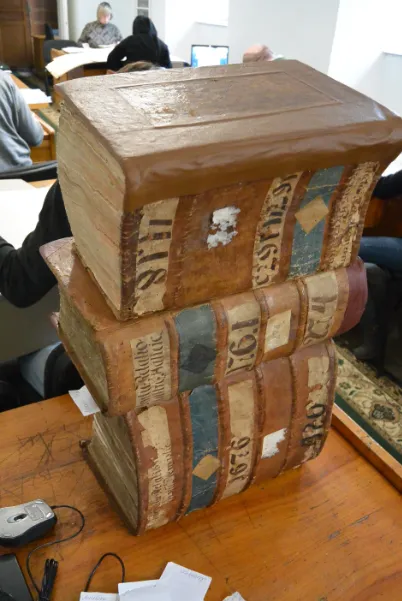
Przemyśl act books of the 17th century in the reading room of the Central Library of the Academy of Sciences
Actually, such a chance is given to us by the Grod and Zemstvo court act books, which were kept in the Ukrainian lands under the rule of the Polish-Lithuanian Commonwealth until the last quarter of the 18th century. Grod and Zemstvo courts in the Polish-Lithuanian Commonwealth were one of the important centers of the country's social life. In these institutions, criminal cases occupied only a small part of the total mass of civil, family, political, tax, and military cases that were filed on the pages of act books. The network of Grod and Zemstvo courts operated primarily for the needs of the privileged class of the Polish-Lithuanian Commonwealth - the nobility. And indeed, the act books of these institutions are the very first basic source for the genealogy of the nobility of the 15th-18th centuries. Grod and Zemstvo courts considered not only disputes between the nobility. The court acted as a universal registrar of the everyday life of the nobility. The deed books recorded contracts for the purchase and sale of estates, lease agreements, mortgages, possessions of estates, marriage contracts, donations of estates, royal privileges on estates, loans of sums of money, and receipts for the payment of certain amounts.
All this shows that the legal culture of the then society in many ways surpassed our modern attitude to various legal subtleties. The document was the basis for ownership of the estate, confirmation of the fact of a loan or lease. In those turbulent times of permanent wars, Tatar attacks, armed conflicts, the original document could easily be lost, but if it was entered in the town or zemstvo book, its legal force was the same as that of the lost document. Since the town and zemstvo books were mainly kept in the centers of the starosts - in fortified royal castles near large and small cities, the chances that these books would be preserved were greater than in the case of documents stored in an ordinary noble courtyard, which could be destroyed during a Tatar attack or an attack by an unfriendly neighbor.
Is there any point in studying such sources when it comes to studying the genealogy of peasants? There is indeed such a reason, but the potential is certainly much smaller than in the case of searching for sources for the genealogy of noble families. The town books could contain lustrations (audits) of villages, there are lists of damages caused to peasants by the military during their posts in the village, complaints of peasants about the inability to pay taxes due to Tatar attacks or other cataclysms, disputes between rural communities and the nobility. On the pages of the act books, one can find numerous mentions of certain settlements, because individual villages and entire estates were the subject of countless property transactions between the nobility. Therefore, it is the entries in the town and zemstvo books that are often the first documentary mentions of certain villages.
Where can a researcher look for city and zemstvo court books? If we talk about the current Lviv, Ivano-Frankivsk, Ternopil regions, and adjacent territories of Poland, then books from these territories are stored in the Central Historical Archive in Lviv. The largest funds are the Lviv, Przemysl, Galicia, Terebovlya and Syanok city and zemstvo books. If we talk about the 17th century, then for example, in Lviv land, an average of one volume per year with a volume of 1000-2000 pages was preserved. Similar sources exist for Volyn and Kyiv region (modern Volyn, Rivne, Zhytomyr and Kyiv regions). These books are stored in the Central Historical Archive in Kyiv. These sources are extremely poorly preserved for Podillia (Vinnytsia, Khmelnytsia, and partly Kirovohrad regions).
Working with city and zemstvo acts requires special skills, because the language of the documents is mostly Latin, less often Polish. For the historical Volyn, Kyiv and Podolsk voivodeships in the 16th century and partly in the 17th century, the Old Ukrainian language was used. Knowledge of languages is not enough, because these books are handwritten, and for the 15th, 16th, and 17th centuries there were their own specific styles of writing, abbreviations, graphemes, which accordingly requires certain paleography skills. If we talk about the chancelleries of the former Ruthenian and Belgian voivodeships, then a beginner should reach for the alphabetical indexes that were compiled by Austrian officials at the end of the 18th century. Although they are very superficial, they greatly facilitate the search for certain settlements and noble families. However, it is also worth contacting specialists. Historians of our historical research agency are one of the few in Central and Eastern Europe who work with similar sources on a commercial basis.
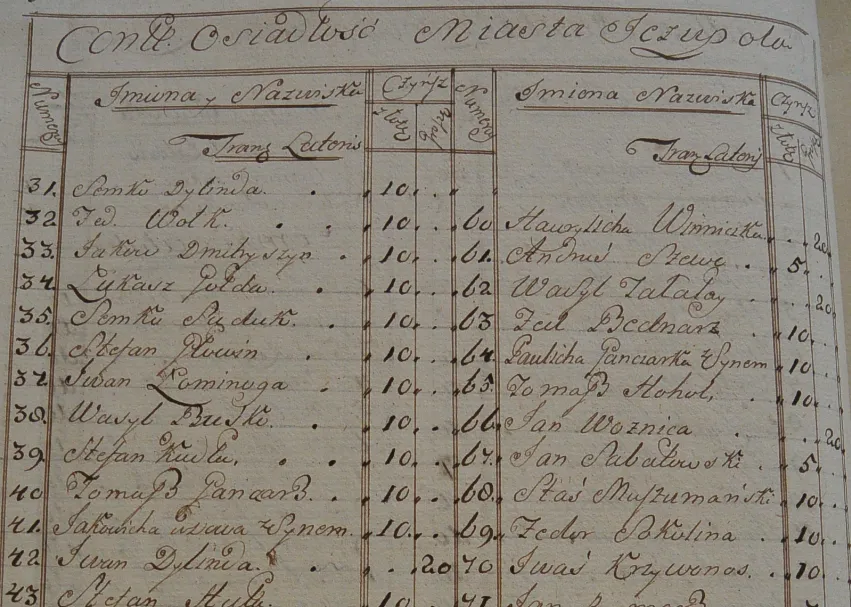
List of residents of Yezupol in the lustration of the city in 1760 on the pages of the act book of the Galician city court
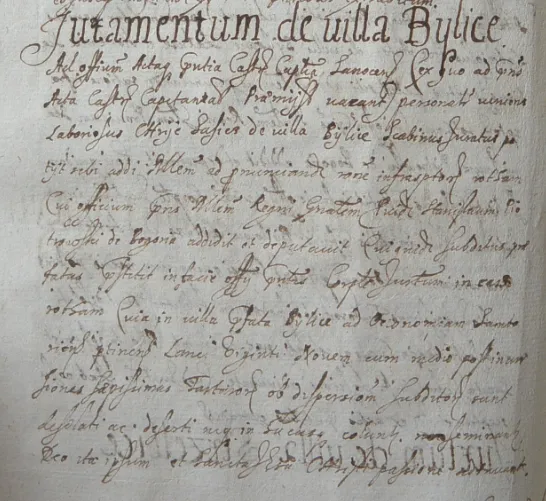
Oath of the peasants of Bylychy about the destruction and damage caused by the Tatars in 1631.
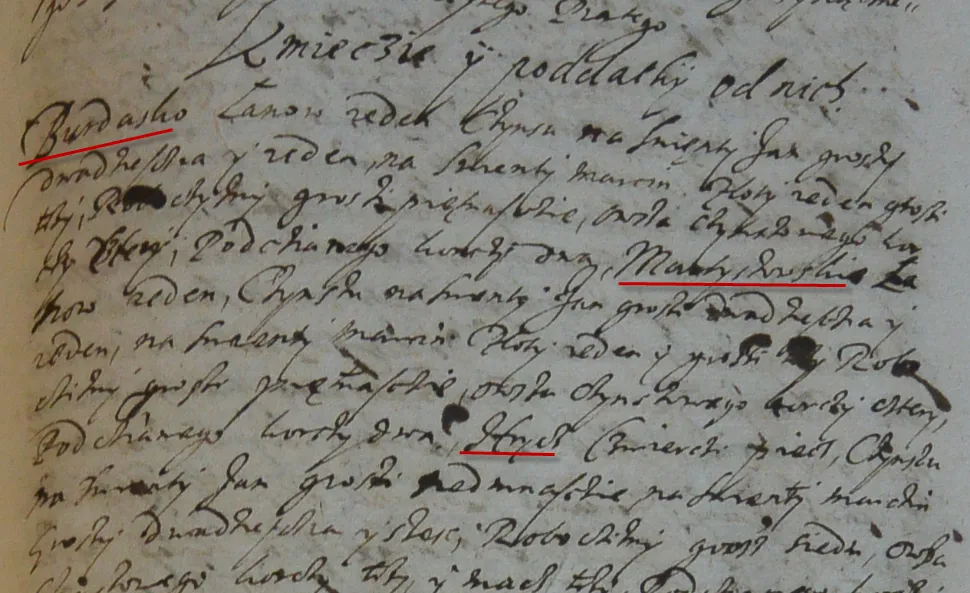
The census of the village of Lyubna from 1627 with a list of peasants and their duties