

The recording of such important events in a person's life as birth, marriage, and death dates back to the oldest written monuments. The metric books in which these events are recorded were generally formed in the 16th century under the influence of the Reformation and Counter-Reformation. The struggle of the Roman Catholic Church with the Protestants transformed the rites of baptism, wedding, and burial from an ancient manifestation of belonging to the followers of Christ into an act of testimony of a Christian's belonging to a particular denomination. These same events led to the appearance of the fourth part of the metric book - the list of parishioners. In Ukraine, the oldest metric books date back to the end of the 16th century. The reform of Metropolitan Petro Mohyla was extremely important for the Orthodox metric tradition. The Book of Requirement published by him in 1646, in its last part, for the first time in the history of the Kyivan church, provided a form of metric records for registering baptisms, weddings, funerals, and compiling lists of parishioners. The introduction of the practice of metrication of parishioners in the Orthodox and Uniate churches was influenced by the older tradition of keeping metric books in Armenian and Latin parishes in Ukrainian lands, which had already been established at that time.
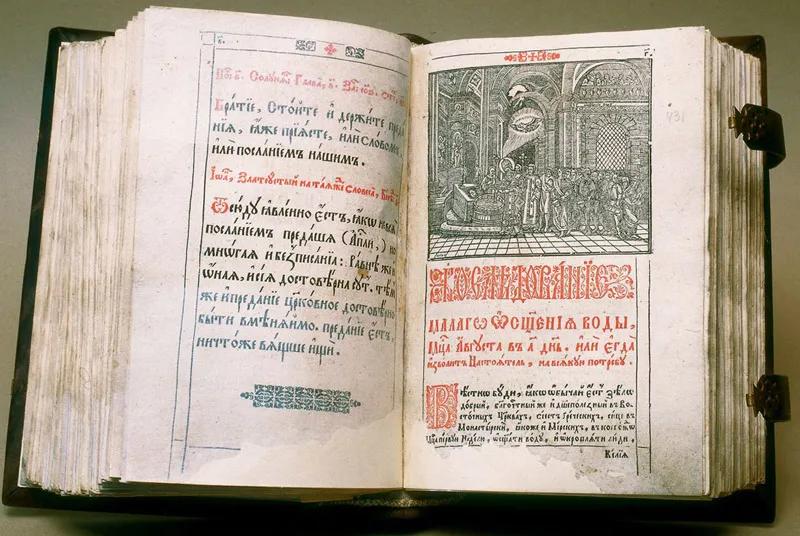
Trebnyk of Peter Mohyla, 1646.
In Lviv, wedding registration was carried out in the period 1642-1680, and baptisms in the Lviv Cathedral were registered from 1674. In the Lviv Armenian parish, registrations appeared long before that (known to researchers, registrations of baptisms from 1636-1733), somewhat later - in the Stanislaviv parish (a book of engagements and marriage contracts was introduced in 1693). The data presented indicate a fairly rapid adaptation of the Eastern churches to the Latin model of accounting for parishioners. A study of copies of the 17th-century registrations preserved in archival, library and museum collections demonstrates that Petro Mohyla's reform did not lead to the mass appearance of registration books in the Orthodox parishes of Ukraine. Petro Mohyla died shortly after the publication of his famous Trebnik, so this liturgical book with examples of metric records, due to its large volume and rather high price, never became a practical guide for clergy. The second reason for the clergy ignoring the canonical requirement to produce and maintain metrics was the opposition of the local Orthodox authorities, which independently published liturgical books and did not want their parish priests to use Petro Mohyla's Trebnik. In particular, in the Lviv diocese in the second half of the 17th century, priests used the so-called Small Trebnik of 1645 by Arseny Zheliborsky, which, although based on the Mogyla model, omitted a number of prayers, trebs, and church regulations, including the metric formulary.
An ordinary clergyman did not have at his disposal a sample form that would clearly indicate how to correctly register baptized, married and deceased parishioners. The example of the Lviv diocese proves that from the middle of the 17th century. until the beginning of the 70s of the same century, metric books appeared only in individual parishes. So, for 1651, only one entry was preserved, another note from the parish priest about baptism comes from 1661, in 1662-1664 one entry was recorded, and for 1665-1667, 1672. no entry was recorded. A similar situation can be observed in the following years: during 1668-1671 and 1673. only one act of baptism was recorded. Separate traces of the Mohyla metric reform are found in the Kholm-Belz diocese.
The first known metric book kept by the Orthodox Church in Ukrainian lands is considered to be the "Prototypon Onoma". It appeared long before the Trebnik of Petro Mohyla: the Cyrillic entries in it date back to 1630-1640. In total, the "Prototypon Onoma" for 1630-1699 contained 918 metric acts, carefully arranged by the "elder" of the St. Nicholas Brotherhood, Grigory Sakevich, and the teacher of the local Russian (Ukrainian) school, Grigory Volostovsky.
Today, the register of baptisms in the village of Rogizna with records for 1662, 1665-1674 has also been preserved. The registers of baptisms from the Przemysl diocese, which were kept in the parish offices of the Church of the Nativity of St. John the Baptist in Przemysl (since 1667), and the church in Yavoriv (since 1670), have also been preserved. The reforms of Peter Mohyla had a resonance in the Orthodox world, as the registers were also introduced in the Uniate Church and in those parishes on the territory of Orthodox dioceses that recognized the supremacy of the Roman Apostolic See. In particular, evidence of attempts to introduce register books in the Uniate churches of the Przemysl diocese has been preserved.
Metric acts were divided into common for all estates - parish (metric) books and records, as well as separate ones for some estates:
- for the nobility (noble genealogical books, general heraldry of noble families and noble lists;
- for the clergy (monastic notebooks and lists of persons of the spiritual office);
- for urban dwellers (urban dwellers' books, which were compiled on the basis of special rules).
- Special acts for the status of urban and rural inhabitants (revision tales, which were compiled according to special provisions provided by the government when appointing each revision).
From the beginning, the structure of the metric book and the metric record form were regulated by the institutions of spiritual authority. In this regard, the date of birth itself was ignored for quite a long time, and instead the date of baptism was recorded, when, according to Christian beliefs, a Christian is born. Therefore, for people born in Ukraine, up to the end of the 18th century, or even the beginning of the 19th century, we do not know and, probably, will never know their full date of birth. Mass-preserved metric books were deposited in Ukrainian archives starting from the second half of the 18th century. These are mainly long-standing church copies that later ended up in the consistory archives. For comparison, it should be noted that in Poland such books have been preserved en masse since the 17th century, although there are many cases of the beginning of keeping metrics that have survived to this day from the 16th century.
On the territory of Right-Bank Ukraine, the mass creation and preservation of not only the parish register but also its annual consistory copy is associated with the beginning of the Russian occupation here (1793). As is known, during the time of the Moscow Tsar, and later the Russian Emperor Peter I, with the abolition of the patriarchate, the process of nationalization of the Orthodox Church began, which ended during the time of Nicholas I with the introduction of so-called states for the clergy and the beginning of the payment of "salaries" following the example of the bureaucracy.
Consequently, the keeping of birth records came under the strict control of the Russian bureaucracy. By the end of the existence of the Russian Empire, a large number of legislative acts and local diocesan orders had appeared, which regulated the keeping of birth records for all Christian denominations and non-Christian beliefs present in the Russian Empire, taking into account numerous circumstances related to social status, age, health status, etc.
As a result of the revolutionary events of 1905, Emperor Nicholas II was forced to liberalize the legislation to some extent, and one of his decisions was to abolish coercion to Orthodoxy. In the Moscow Kingdom, the first decree on birth records dates back to 1702, when Peter the Great issued a decree requiring all parish priests in the city of Moscow to submit weekly information on all cases of births and burials to the patriarchal spiritual order. The widespread keeping of parish records, initially only for the Orthodox population, began no earlier than 1722. Judging by the forms of the records added to the Synodal Decree of 1724, they were kept in three parts and contained the following information: about births - the person to whom the child was born, baptism and data on the godparents; about persons who entered into marriage - data on the persons who were married, as well as witnesses, and the day of the wedding; about the deceased – who died, cause of death (illness), when and where they were buried.
But the correct keeping of birth records did not spread so quickly in the network of church parishes. In 1825, the Synod ordered the bishops to eradicate bribery, which had become entrenched in institutions through the keeping of civil status records, and especially in consistories. In 1806, printed forms of books were first introduced, and in 1838 a decree was adopted according to which parents, godparents and witnesses confirmed the correctness of the entry in the birth record book with their signature. Laws on the permanent and correct keeping of birth records were issued: for Catholics in 1826, for Muslims in 1828 and 1832, for Lutherans in 1832, for Jews in 1835.
All entries in the register books were made by the parish (for military personnel – by the military) clergy. The originals of the register books of the Orthodox were kept in the consistories, and copies remained in the churches. Three register books were kept for all confessions: births, marriages and deaths; for Jews and Muslims, divorces were also recorded in the marriage books. The form of the book is the same for all confessions in the sense that all the facts entered into the acts of estates are entered into the columns, but the content of the acts differs in different confessions.
So, behind the practice of metrication, there is a certain historical tradition, which begins with the emergence and spread of the first metric books on the territory of Ukraine, and the gradual establishment of these practices as universally mandatory in the 18th century.