
When we first started our commercial activities in the field of genealogical research in 2013, the opportunity to work with digital copies of archival documents from home, without visiting the archive, seemed like a very distant prospect. Less than ten years have passed since truly impressive changes have taken place in this area. With this article, we begin a series of materials in which we will try to outline the state of digitization of archival documents in Ukraine and tell you what of them can already be found on the Internet.
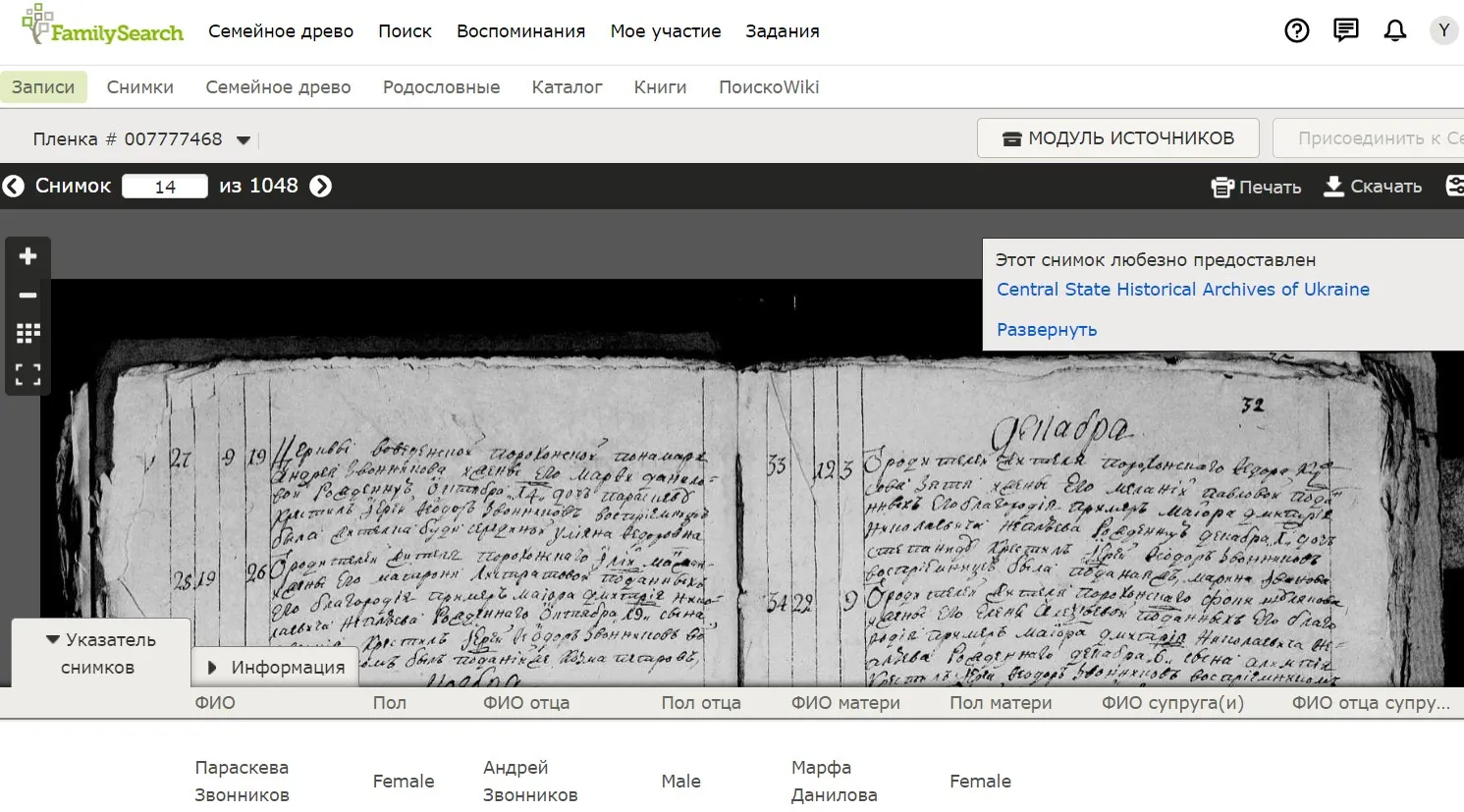
Viewing a birth record through FamilySearch
Back in the 2000s, the Utah Genealogical Society (better known through the FamilySearch resource) carried out a powerful work on copying documents in Ukrainian archives. At that time, mainly metric books were copied and digitized, which at that time were stored in the central historical archives in Kyiv and Lviv, as well as in the regional archives of Dnipro, Donetsk, Luhansk, Mykolaiv, Poltava, Odessa, Sumy, Chernihiv, Cherkasy, Chernivtsi, and Kharkiv. For a long time, copies of these documents could be viewed only in the family history centers of the Church of Jesus Christ of Latter-day Saints. A few years ago, viewing became available to users from Ukraine through the FamilySearch platform. This greatly simplifies the work of genealogy researchers, because most of the metric books of the late 18th and 19th centuries in the archives with which FamilySearch has managed to cooperate are available online. About, how to work with FamilySearch and how to search for birth records on it, we wrote in a separate article. We will only add that the cooperation between FamilySearch and Ukrainian archives has recently resumed, so in the coming years the number of birth records and other genealogical sources available for viewing online will increase significantly.
Today, the digitization of archival documents and their publication in open access is actively carried out by Ukrainian archives. Changes in this direction have significantly accelerated after the State Archival Service of Ukraine was headed by a new leadership in the person of Anatoly Khromov. The coronavirus epidemic has significantly updated the work on digitizing the archival fund of Ukraine. The reading rooms of archives have been closed to visitors for many months. In these conditions, archives have begun to more actively post their materials on their own websites. Today, on the page of each regional or central archive, you can find the E-archive section. Here, they began to publish mainly those cases that are particularly in demand among researchers, in particular, metric books. The pace of filling in different archives is different, but this initiative is very important. The digitization issue has gained particular importance in light of the Russian-Ukrainian war. A number of archives have found themselves in a combat zone or under Russian occupation, so there is a threat of losing our national archival fund. In view of this, creating and preserving at least digital copies of documents is a critically important matter.
Let's start our review of what can already be found online from archive collections with the central archival institutions of Ukraine:
Central State Historical Archive of Ukraine in Kyiv (CSIAK) – the main and largest archival institution of Ukraine. The Archive has long developed an online index to its collection of birth records. A considerable amount of documents was digitized by order of FamilySearch back in the 2000s – these are hundreds of birth records, as well as dozens of confessional inscriptions. However, many birth records from the Central Archives of the Ukrainian History and Culture did not have time to be digitized – in particular, books from the 1078 inventory of fund 124. Work on making the Central Archives of the Ukrainian History and Culture available online has been revived recently. On the archive page in the E-archive section Gradually, metric books, materials from the Rumyantsev census, and old act books that cannot be obtained in original form in the archive reading room are appearing. Among the items presented in digital access are old acts: lustrations of kingdoms during the Polish-Lithuanian Commonwealth (f. 1), documents of monasteries, Cossack regiments, and personal funds (Hrushevsky). It is pleasing that the archive page primarily includes those metric books that are not on the FamilySearch website.
The E-Directory section (online directories) contains descriptions of dozens of CDIAK holdings. The ability to work with descriptions remotely saves a lot of time for the researcher, by selecting the archival files needed for processing remotely.
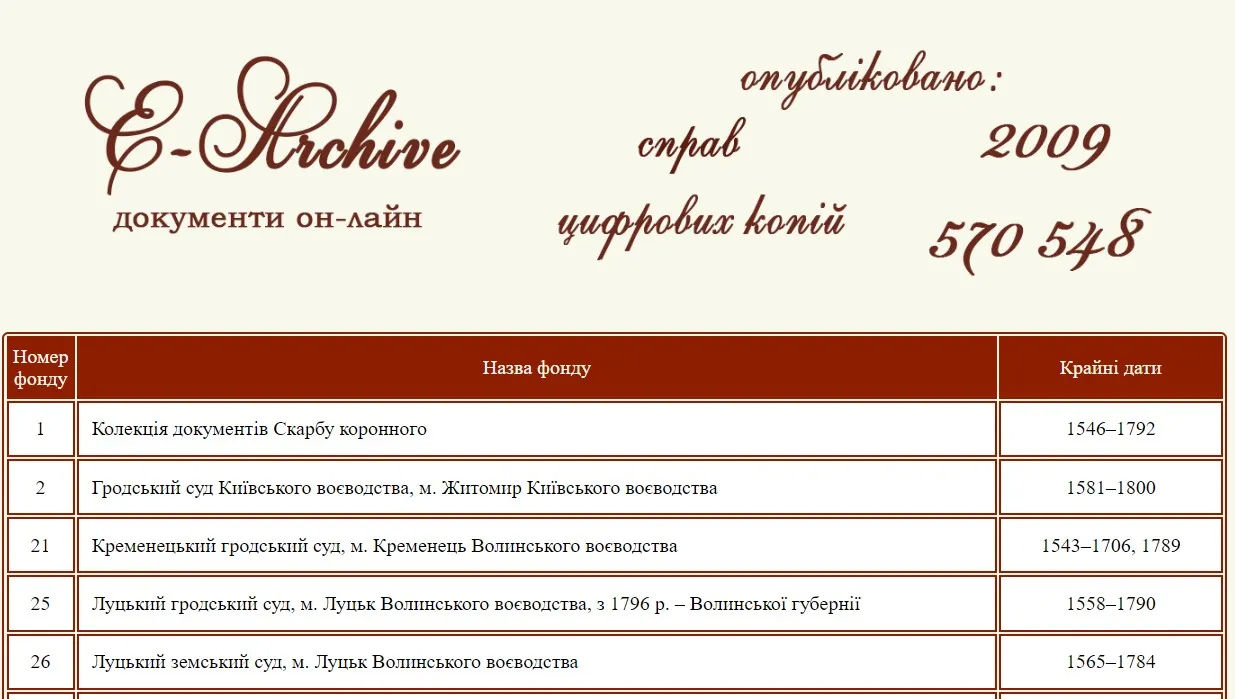
E-Archive page on the website of the Central State Historical Archive of Ukraine in Kyiv
Central Ancient Historical Archive in Lviv contains a colossally rich collection of documents on the history of Galicia. So far, the central archival institution has a modestly filled E-Archive section – these are documents from funds 12 (Perevorsk Grodsky court), 132 (collection of letters of state, public and church figures 1516-1888) and 310 (Ukrainian University in Lviv), which are not in great demand by researchers, as well as the more popular fund 618, which contains church registers. However, the registers made available for access can still be found on FamilySearch, as can most of the registers from this archive. The situation is much better with the reference system, as dozens of descriptions of the CDIAL funds are already available for viewing on the site.
Central State Archive of Higher Authorities and Administration of Ukraine (CSAVO of Ukraine) preserves documents of state authorities that operated in Ukraine during the 20th century - these are the documentation of the Central Council, the bodies of the UNR, the state of Pavlo Skoropadsky, the Directory, the Soviet period and the German occupation. Today, hundreds of documents on the history of the National Revolution of 1917-1921, materials related to such figures as Symon Petliura, Mykhailo Hrushevsky and others are available online.
In the following articles, we will tell you what can be found online from the collections of regional archives of Ukraine.