
Every year, the number of archival materials available online increases on the Internet. The level of digitization of archival funds, in particular genealogical materials in Western countries, can only cause envy among domestic researchers. Nevertheless, over the past decade, Ukrainian researchers of genealogy and pedigrees have also had many opportunities to come across information about their ancestors without leaving home, even using foreign Internet resources. Databases are gradually appearing, which are created and filled by Ukrainian enthusiasts. In the article, we have collected a selection of Internet resources from which you should start researching your family tree even before going to the archive…
We will begin our review with the Family Search resource, because this genealogical search site is one of the largest platforms containing a huge collection of archival and library materials from different countries of the world, including Ukrainian ones. The database operates with the support of the Church of Jesus Christ of Latter-day Saints, and is also filled and indexed by volunteers. The Genealogical Society was founded in 1894, and since 1938 they began to accumulate collections of genealogical materials. Based on the data received and genealogical research, the Mormons decided in 1998 to create the Family Search site in order to help people find their roots. This site offers free access to thousands of documents and archival data from more than a hundred countries of the world. The developed site, in addition to access to genealogical materials, allows all users to familiarize themselves with free training courses on genealogy research. Today, the Family Search resource presents birth records, confession lists, and other genealogical sources from the Central Historical Archives in Kyiv and Lviv, as well as a number of other regional archives. More about, how to use the Family Search genealogy search and research platform you can read in a separate article.

2. National Bank of the Repressed
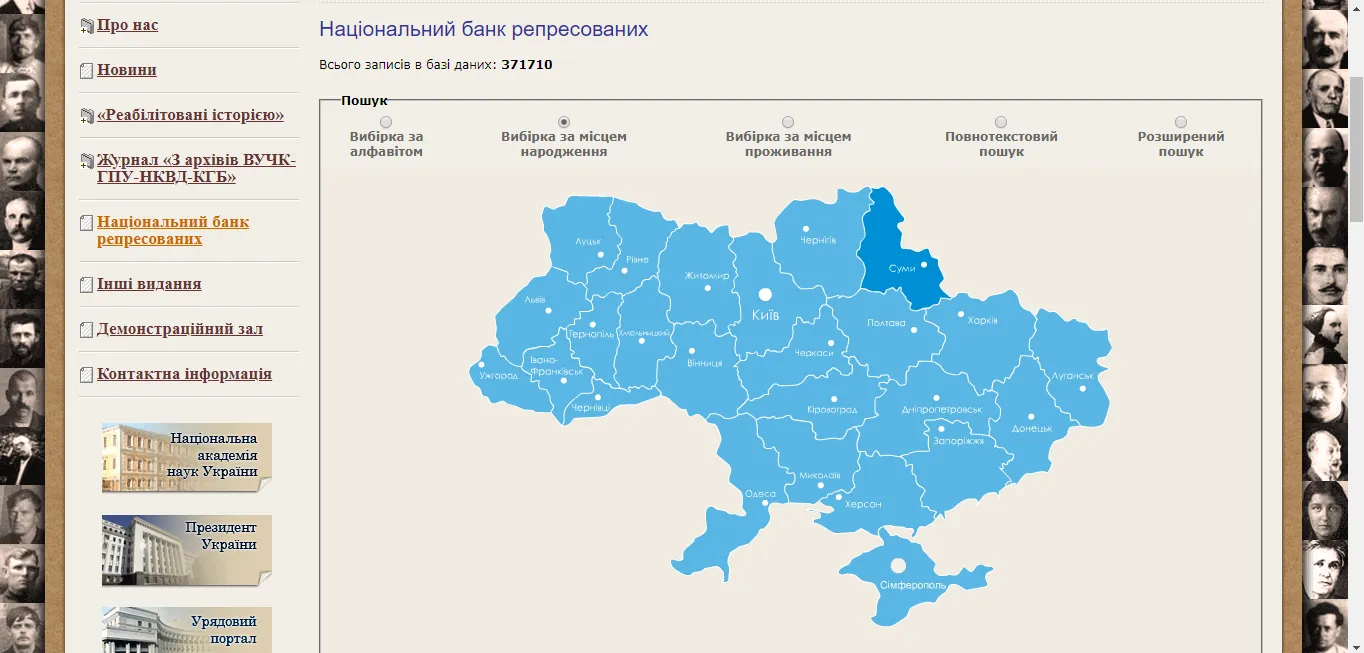
The Ukrainian Institute of National Remembrance has developed an online project called "National Data Bank of Victims of Political Repressions of the Soviet Era in Ukraine." The database contains information on 371,710,000 repressed citizens from different regions of Ukraine. This list contains information on repressed citizens from the period of Soviet occupation from 1917 to 1991. The resource will be of interest primarily to those whose relatives once suffered from the repressive machine of the Soviet Union. The database is compiled on the basis of materials from the multi-volume series of books "Rehabilitated by History," so you can also use the printed version of these materials.
On the site, you can search for the person you need by different categories: alphabetically (person's last name), by place of birth, by place of residence (the site shows a map of Ukraine, with which you can select the desired settlement), full-text search (with the specified place of residence and birth), as well as full-text search, where you can indicate the nationality of the person, their education, social origin, as well as brief information about their work, scientific, political activities, the circumstances under which this person was repressed and further measures and information about the fate of this person. The information has been checked against documentary sources and guarantees complete reliability. The database contains only small text references about repressed persons, however, having found the personalities you need, you can then order all investigative and criminal cases in the archives of the Security Service of Ukraine or the Ministry of Internal Affairs.
3. Collections of documents and metric books from the Main Archive of Ancient Acts in Warsaw
The Main Archive of Ancient Acts in Warsaw is one of the leading archival institutions in Poland. The archive has carried out extensive work on digitizing the most requested files by users, which also include birth records. Due to certain historical circumstances, many birth records from Ukrainian lands ended up in the archive's collection. This applies to birth records of both Roman Catholics and Greek Catholics and Orthodox. There are also birth records of Lutheran, Evangelical and Jewish communities. All of these materials are available online today. These are mainly birth records from the Lviv, Przemyśl, Lutsk and Stanisław archdioceses from 1728 to 1951. The search should be carried out by selecting the desired denomination and diocese, and then using the geographical index.
4.Search w archive (Search the archives)
An excellent resource for searching for materials and documents stored in Polish archival institutions. The database contains not only the names of archival files, but also tens of millions of digital copies of documents that can be viewed online. Access to all materials in the szukajwarchiwach database is absolutely free - you do not need to register or pay any fees for using the materials. The compiler, creator and administrator of the site is the National Digital Archive. The first version of the resource was released in 2009 and since then this site has been constantly improving its work, supplementing the database and is considered one of the most popular genealogical platforms in Poland. The site presents selected collections of archives from the Integrated Archival System (ZoSIA) and the Database of Civil Status and Metrics Acts (PRADZIAD) - in which state archives accumulated information about genealogical materials. It is best to search the database geographically - by entering the name of the locality where your ancestors lived in the search. However, it is also worth trying to search by specific surname.
5 Pra.in.ua – Database of Ukrainian residents 1650-1920.
The Pra.in.ua project was conceived as the largest domestic genealogical database of residents of Ukrainian lands who were born between 1650 and 1920. Today, the creators of the resource claim that the site's information database includes more than 3.3 million people. The developers of this project note that in 2020 the database will reach 5 million records. The site is quite interactive. The user can add personal information to the database or edit existing records. Each researcher has the opportunity to create their own family tree. The "pra analytics" system will compare the project database updates with your genealogical data every day. If the search engine detects potential family ties, you will be notified. The main sources of the information base include birth records and confessional registers – both Catholic and Orthodox, as well as birth records of colonists from Germany and the Czech Republic, sworn lists, voivodeship bulletins, population censuses, lists of soldiers and repressed persons, and much more. Using the map, you can view settlements and analyze information about the population in different time periods. However, the resource also has certain shortcomings, perhaps the main one of which is the lack of references to documents and sources for the records available in the database.
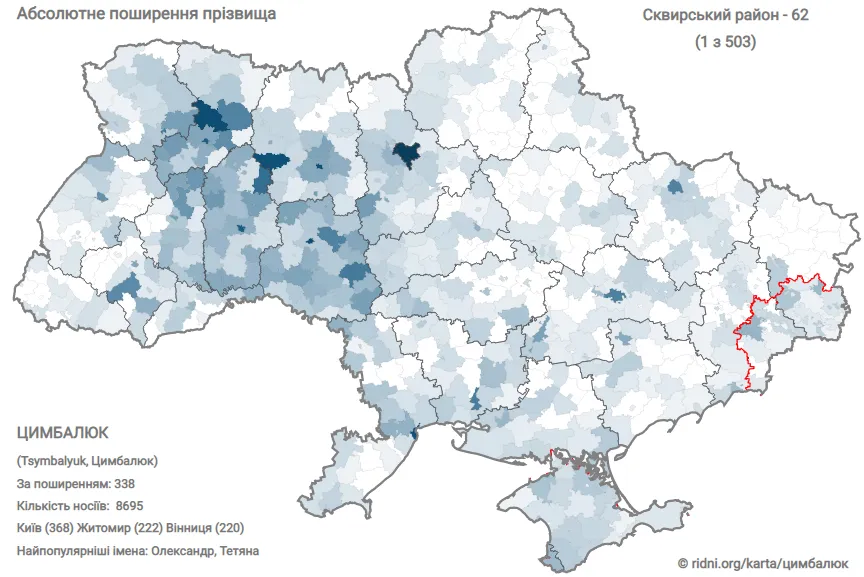
A useful online resource is the map of the distribution of surnames in Ukraine. This resource provides a fairly accurate number of carriers of certain surnames in Ukraine, highlighting on the map the areas of their greatest distribution. With the help of the map of the distribution of surnames, we can find out how common a particular surname is, and visually track the main areas of its distribution in Ukrainian lands.
7. CaitThe Statue of Liberty - Ellis Island Foundation.
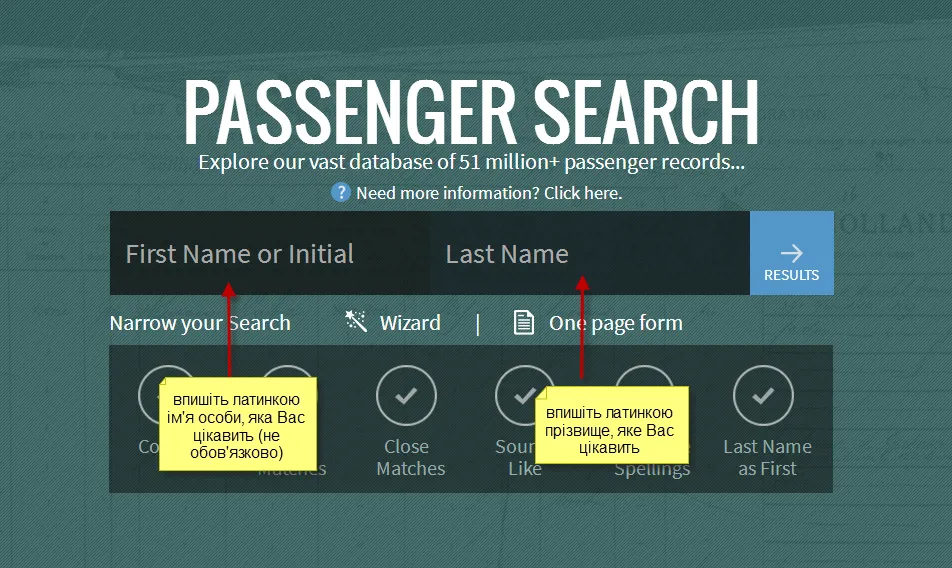
This resource allows you to track information about people who migrated to the United States at one time. Only in the period from 1892 to 1924, more than 16 million people came to America through Ellis Island. One third of them settled in New York. Today, data on legal immigrants who migrated to America through this island is in digitized format and any user has free access to familiarize themselves with these materials.
The list of migrants provides information about the migrant's identity, date of arrival in the US, previous place of residence, and even the name of the ship on which the person traveled to America. For a more detailed overview of the work with the database of migrants to the US, read a separate article.
8. Information portal “First World War 1914-1918”
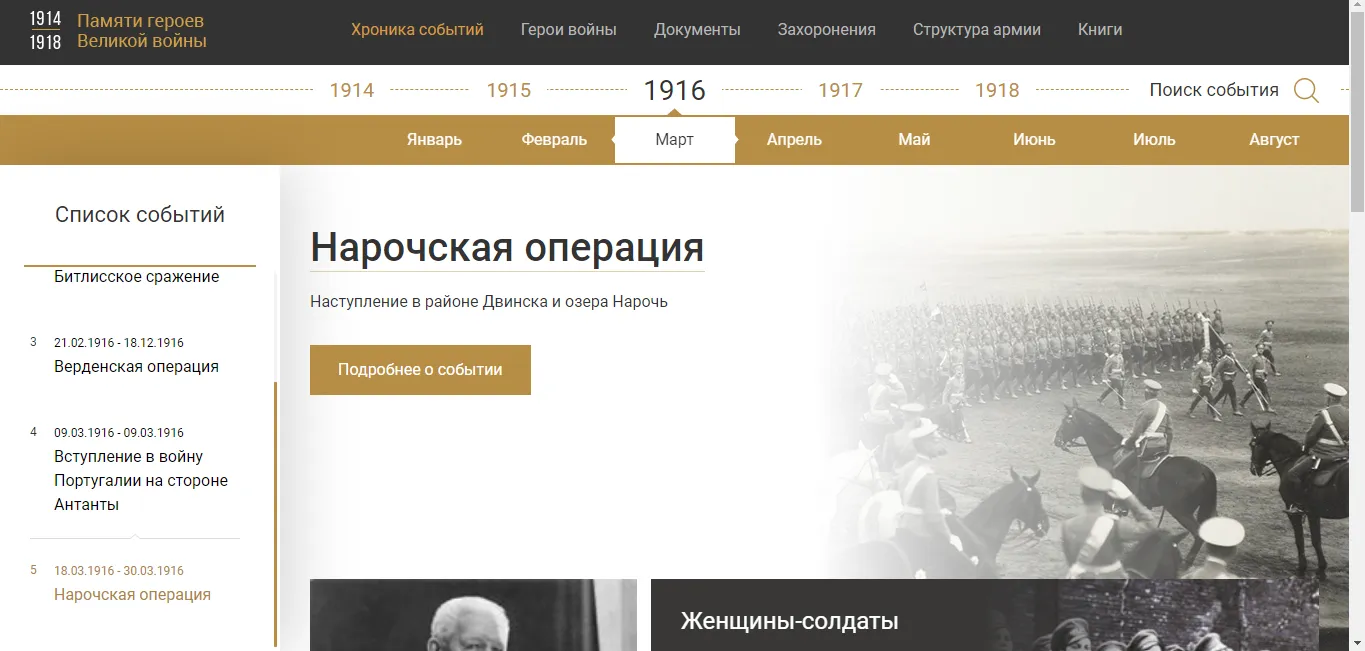
This information resource is an official document bank containing information about participants in the events of the First World War. The site is an indispensable tool for searching for information about relatives who served in the Russian Imperial Army from 1914 to 1918. The number of records entered into the database already exceeds several million and mainly concerns information about wounded, dead and missing soldiers. The information resource also contains records of awards. The researcher has the opportunity to familiarize himself not only with the content of the document, but also to view or download its scanned copy.
9. Electronic document bank «The memory of the people»
Despite the ideological burden that this resource carries in the post-Soviet space, today it is almost the main opportunity for the user to get remote access to the most complete information about the participants of World War II. In fact, the resource generates data from two older, large banks of information about the soldiers of the Red Army in World War II - "Memorial" and "Podvig Naroda".
On the site you can determine the fate of relatives who fought in the ranks of the Red Army during World War II, find information about their awards and get data on reports of the dead and missing. In addition, the site provides access to more than 100 thousand scanned military maps. The portal also collects and publishes information about the places of primary burial of more than 5 million soldiers and officers who died in battle or died of wounds and illnesses in hospitals and medical battalions. All records are accompanied by scans of documents, which can be downloaded from the site in good resolution.
Searching on the site is quite easy and straightforward. The only thing is that you should search for the right person not only by the name of the settlement, but also by the name of the district, since often the name of the village in the documents could be distorted or omitted altogether.
The list of online resources that facilitate the work of a genealogist can be continued, which we will definitely do in our next publications. In the comments, you can indicate which online resources for genealogy research you would be interested in reviewing. Let us remember that in Ukrainian realities, the full digitalization of archival documents is still too far away, so most of the resources listed in our material are only a support and assistance in comprehensive genealogy research, which today is still rarely possible to conduct without a researcher's visit to the archive.